In this article
Financial discipline matters. But when security is out of reach, the answer cannot simply be another lesson in starting from zero.
I recently came across a Facebook reel with a familiar promise: broke at 35? Here is how to rebuild.
The graphic shows a man pushing a boulder marked $0 uphill towards $1 million. The steps are simple: build a $1,000 buffer, pay off debt, invest.
What struck me was not the advice. It was the age in the headline.
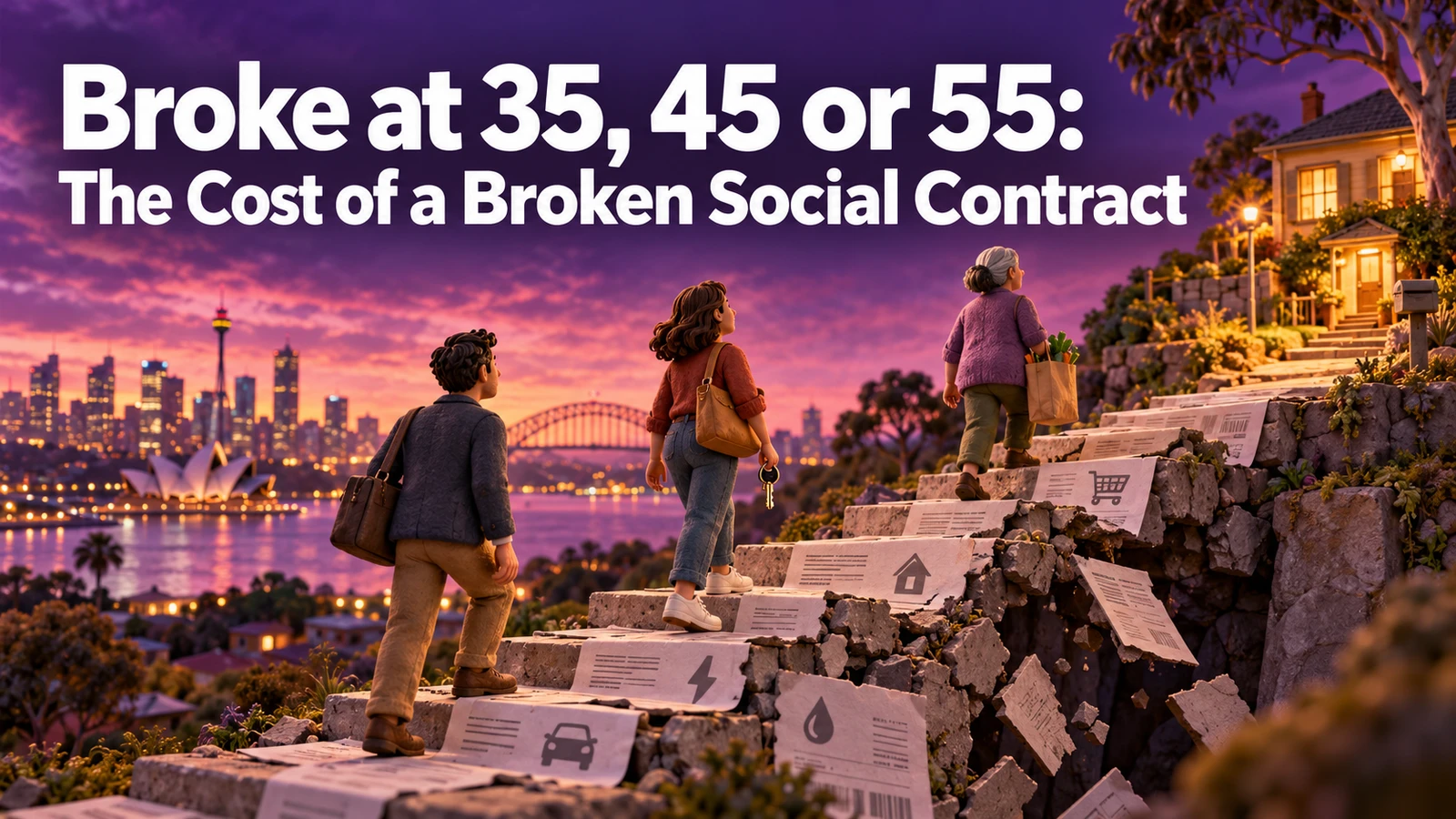
My concern is that we are going to see much more of this content, with the age moving upwards. Broke at 45. Starting again at 55. Rebuilding at 65, when the conversation should be about retirement rather than recovery.
One reel is not evidence of a population-wide trend. But it raises a question worth testing against something more substantial than a social media feed:
Why should people who have spent years working and contributing to society have to keep learning how to start from zero?
The missing step is having money left
There is nothing wrong with helping someone regain control of their finances. A manageable plan can offer hope at a moment when everything feels overwhelming. People should not be written off because they have reached a particular age without savings or a home.
The problem begins when personal-finance advice is treated as a complete explanation for financial insecurity.
A savings plan needs something to save. An investment plan needs money that is not already committed to keeping a roof overhead. A recovery plan needs enough stability for its progress to last.
Consider two people with the same income and equally careful budgets. One has secure housing and family able to help in an emergency. The other rents alone and has no financial back-up. The same setback does not leave them in the same position.
That is not an argument against personal responsibility. It is an argument against confusing responsibility with control.
You can be responsible for managing your circumstances without being responsible for every circumstance you face.
Housing makes the limits of budgeting obvious
Australia's National Housing Supply and Affordability Council reported in August 2026 that dwelling prices had grown significantly faster than wages since December 2015. That pattern held in every state and territory except the Northern Territory.
This does not mean nobody can get ahead. It does mean the target has been moving faster than the wage measure used to assess people's ability to reach it.
Renters face their own version of the problem. The Australian Institute of Health and Welfare (AIHW), citing Cotality, reported a national median weekly rent of A$681 in December 2025, A$204 higher than in 2020.
At that benchmark, an A$1,000 emergency fund would not cover two weeks of rent, before food, transport or electricity. That is a comparison with a national property-market figure, not a claim that every renter pays the same amount.
The point is not that a small buffer is worthless. It is that the scale of the protection matters.
A government should not be able to celebrate rising property wealth without answering for what those prices mean to people still trying to secure a home. For them, the headline about wealth creation can look more like a higher barrier to entry.
This is not only a young person's problem
It is tempting to frame financial insecurity as a generational dispute: younger people struggling to get started versus older people who have already made it.
That leaves too many people out.
Grattan Institute research published in 2025 found that homeownership among the poorest 40% of Australians aged 45–54 fell from 68% in 1981 to 54% in 2021. These are comparisons between age groups at different points in time, not a study following the same individuals.
The important point is that the deterioration reaches well into middle age. It is not confined to people leaving university or looking for their first job.
There is also a warning in homelessness-service data. The AIHW reported that the monthly number of clients aged 50 and over rose from around 11,200 in March 2018 to 17,300 in March 2026, an increase of approximately 54%. It compared that with about 18% growth in the population aged 50 and over, using a projected population figure for 2026.
The March 2026 service data are preliminary. They include people at risk of homelessness as well as people experiencing it, and they are not a count of every older Australian without a home.
Even with those qualifications, this should disturb the comfortable assumption that financial vulnerability is something people simply age out of.
A financial reset at 55 is not the same as one at 25. Someone aiming to retire at 65 has ten years to rebuild rather than forty. That is not a judgement about their capacity or worth. It is a difference in time.
Nor does “starting from zero” always mean literally having no assets. Someone may have retirement savings but little accessible cash. Another person may have debt, insecure accommodation or caring responsibilities. A single motivational slogan cannot adequately describe all of those situations.
What the Greens' $1,000 proposal does, and does not, answer
The Australian Greens' recent proposal belongs in this discussion, but it needs to be described accurately.
At a National Press Club address on 28 October 2026, David Shoebridge outlined a plan to raise the tax-free threshold from A$18,200 to A$26,000. The party's published summary describes more than A$1,000 in annual relief for almost every working Australian, alongside an annual increase of A$1,000 for people receiving income support.
This is a proposal for ongoing annual relief, not an approved, one-off stimulus cheque.
ABC reporting ahead of the announcement put the maximum tax saving at A$1,092 a year and described an equivalent income-support increase. It reported a Parliamentary Budget Office costing of A$22 billion annually for the package, while noting that the proposed resource-tax funding measures had not been formally costed by the PBO and that some design details remained unresolved.
The difference between the party's rounded A$1,000 description and the ABC's A$1,092 reporting is worth retaining rather than pretending the proposal is already a finalised payment scheme.
An extra A$1,000 a year could matter enormously to someone struggling to pay for essentials. Dismissing it as trivial would miss the point of providing relief.
It would also be unfair to portray the entire proposal as a cash handout. Changing the tax-free threshold and how resource wealth is taxed concerns the structure of the tax system itself.
But the test for this proposal, or any government's cost-of-living package, should go beyond the amount announced: does it help people become more secure, and how does it fit with housing, employment and public services?
Relief and reform are not alternatives. People need support now and a credible reason to believe they will need less emergency support later.
When financial pressure becomes a political grievance
The demonstrations in Germany and France bring another dimension to this argument.
Reuters reported demonstrations across 34 German cities on 31 October 2026, with demands including lower living costs, better education and opposition to compulsory military service. Authorities described the demonstrations as largely peaceful, although stores were looted in Frankfurt and violence occurred.
In France, Reuters reported a third weekend of protests on the same date, driven by grievances including living costs and strained public services. Largely peaceful afternoon demonstrations were followed by clashes in some cities.
These are not interchangeable movements, and they do not establish a single worldwide cause of unrest. The German protests, for example, included a specific dispute over military service. Nor should peaceful demonstrators be conflated with people committing violence or looting.
What I take from this is more limited, but still important: the affordability of an ordinary life is a political issue, not merely a private budgeting exercise.
Governments should not have to wait for unrest before treating that issue seriously. And public anger should not have to become destructive to earn a response.
Further reporting: BBC News, Shops looted as German cost of living protests turn violent.
Governments should be judged on whether security is achievable
Saying governments have failed society is a serious charge. It should be grounded in outcomes, not used as a substitute for examining them.
Governments cannot prevent every redundancy, relationship breakdown or economic shock. Different countries have different institutions and constraints. Employers, markets and individual decisions also matter.
But those qualifications do not remove political responsibility. The rules governing housing, taxation, income support and public services are not beyond democratic choice. Governments should be judged on whether those rules give people a realistic chance to build lasting security, and recover when something goes wrong.
For me, that means three tests.
Can people secure a stable home? Policy should address the supply of homes where they are needed, social housing and the security of people who rent. It should also examine whether tax and planning settings help people find somewhere to live or disproportionately protect the advantages of those already established.
Can people survive a setback without losing everything? Income support, accessible healthcare and practical routes back into suitable work should help prevent a temporary interruption from becoming a long-term crisis. “Retrain” is not an adequate answer unless there is a realistic connection between the training, available jobs and a person's circumstances. Employers have a responsibility here too: experience should count, and recruitment should not treat a disrupted career as evidence of personal failure. Basic dignity should not depend on an uninterrupted employment record.
Are the promises credible? Reforms need transparent costings, workable implementation and honest discussion of who pays. An ambitious announcement is not the same as a funded programme, and a funded programme is not the same as a successful outcome.
None of this guarantees everybody a house, a high salary or a setback-free life. The standard is more basic: people should have a fair chance to turn effort into stability, rather than depend on exceptional luck to remain financially afloat.
People deserve more than an inspiring comeback story
I do not object to the encouragement in that reel. Someone rebuilding at 35, 55 or any other age deserves hope, useful information and respect.
What I object to is the possibility that we normalise the need to rebuild while leaving its preventable causes untouched.
The answer cannot always be to work harder, become more resilient and start again. Resilience should help people through hardship. It should not become an excuse for institutions to tolerate avoidable insecurity.
If financial-reset advice becomes an increasingly familiar message for people further into adulthood, I do not want our only response to be a better savings checklist.
I want us to ask what happened to the expectation that years of work and contribution should offer a reasonable prospect of security.
A functioning society should help people recover from setbacks. It should also make it less likely that an ordinary setback forces them to rebuild their entire lives.
The question is not only how to start again.
It is why starting again should have to become a way of life.
Opinion and analysis. Research checked on 2 November 2026, Australia/Sydney. Australian policy and housing amounts are in Australian dollars; the original reel's currency is unspecified. Statistics retain their original reference periods and are not presented as real-time measurements.
Thanks for reading. About reader stats
Get in touch ↗







Join the conversation
Comments and reactions use GitHub. Sign in to join in, and keep the discussion thoughtful and respectful.
View discussions on GitHub ↗