
In this article
For workers already feeling cooked, the money and confidence needed to walk away can be harder to find. AI and repeated job cuts are adding another reason to stay put.
There is a particular kind of exhaustion that comes from a job you cannot afford to leave.
You might still like parts of the work. You might be good at it. You might even earn a salary that looks comfortable from the outside. But after housing, bills and the ordinary cost of being alive, there is little room to stop. A difficult week becomes a difficult year because taking a break requires money you are still trying to save.
Then another company announces redundancies. Another executive explains how AI will allow a smaller team to do more. You look at the jobs available, consider what a few months without income would mean, and decide to keep going.
People in that position can become more and more cooked while appearing, on paper, to be doing fine. They remain employed. They meet deadlines. Their employer records another year of retention.
The question is how much of that staying is a choice.
The money that lets you say no
There is a blunt expression for the freedom to walk away: fuck you money.
I mean enough money to leave a job without having to accept the next available one in a panic. Enough to recover, try working for yourself, study something different or spend some time in the world without having to justify every day through paid employment.
That amount will look different for everyone. A person with dependants, rent and medical expenses faces a different calculation from someone who can move back into a family home. The relevant measure is how much time their accessible savings can buy.
Consider a simple hypothetical. A$20,000 covers five months of expenses at A$4,000 a month. At A$5,000 a month, it covers four. The account balance is identical, but a month of freedom has disappeared before allowing for emergencies or the cost of retraining.
Confidence in finding another job matters too. Someone who expects to replace their income quickly may feel able to take a break. Someone worried about a long search may treat every dollar as money they cannot touch. The cushion can lose practical value without the balance falling.
Australia's financial picture is uneven. The Reserve Bank reported that real disposable income per person fell slightly in the first half of 2026, although it remained above 2023 and 2024 levels. Lower-income households, many of them renters, were more exposed to cost pressures. At the same time, most mortgage borrowers retained substantial savings buffers. 1
That distinction matters. Some people have considerable freedom; others have very little. Being able to keep paying the bills while employed also tells us surprisingly little about being able to stop earning. Money reserved for an emergency does not automatically feel available for a career experiment.
Staying can conceal dissatisfaction
A person can stay because they love their work. They can also stay because they cannot see a safe way out. An employer looking only at staff turnover can miss the difference.
Gallup's late-2025 US survey captured that tension. Only 28% of workers thought it was a good time to find a quality job, down from 70% in mid-2022. More than half were actively looking or watching for opportunities. Those are US findings, but they illustrate how wanting a change can coexist with pessimism about making one. 2
The BBC's The Global Story explored the changing mood with organisational behaviour professor Anthony Klotz and Financial Times columnist Sarah O'Connor. In his summary of their conversation, Klotz described a move from the Great Resignation to the "Great Hunkering Down", a phrase coined by O'Connor. He argued that the economy and labour market had changed dramatically while workers' feelings about work remained more familiar. That is a useful distinction: fewer resignations do not, by themselves, demonstrate greater satisfaction. 3
Financial pressure changes the questions a person asks about their job. Whether it is interesting or meaningful still matters. So does whether they can risk losing its income, flexibility or predictable hours. Someone who feels stuck may accept conditions they would otherwise challenge.
For an exhausted worker, moving jobs creates another demand on the same depleted energy. Applications, interviews and learning a new workplace have to fit around the job already wearing them down. It is possible to spend so much effort remaining employable that there is little energy left for the life employment is supposed to support.
None of this requires everyone to hate their job. Enjoying the work and feeling financially trapped can exist in the same person. Job satisfaction becomes harder to interpret when staying is the only option that feels affordable.
The job is bigger than its paid hours
Part of the grind is that employment can claim much more of your week than the hours on your contract. Alongside the work itself come commuting, getting ready, unpaid breaks and organising everything else around the working day. Recovery can take another part of the evening.
As an illustration, a 38-hour week with an hour of commuting each working day and a daily half-hour unpaid lunch occupies 45.5 hours, before preparation or recovery. Those extra hours are not all work in the contractual sense, but they still limit what you can do with your time.
There is also the question of control. Self-determination theory identifies three basic psychological needs: autonomy, competence and relatedness. In everyday terms, that includes having a sense of choice, feeling capable and feeling connected to other people. Autonomy does not require working alone or ignoring a team's needs. It concerns whether you have a meaningful say in how you act. 14
You can enjoy solving technical problems while resenting having every hour prescribed: when to arrive, when to eat, which task must interrupt another and when you may leave. The work may be worthwhile while the structure around it leaves you drained.
Financial dependence makes those arrangements harder to challenge. When rent and essential expenses depend on the next pay cheque, requesting flexibility can feel like a risk you cannot afford. Staying employed may protect your income while leaving little room to negotiate how much of your life the job occupies.
The eight-hour day was a limit, not a productivity law
The eight-hour-day movement sought protection from much longer working days. In Australia, Melbourne stonemasons won an important eight-hour-day victory in 1856. The movement's familiar slogan divided the day between eight hours of labour, eight of recreation and eight of rest. That was a hard-won claim to a life outside work. 15
That history does not establish eight hours as the ideal daily dose of software development, design or concentrated problem-solving. Nor are the eight-hour day, the five-day week and a particular 9-to-5 schedule the same thing. They concern different decisions about the length and organisation of work.
Fixed schedules still have practical value. Hospitals need staffed shifts, customers need support coverage, and colleagues sometimes need to be available together. But a need for reliable coverage does not automatically require every knowledge worker to maintain eight consecutive hours of visible activity.
Imagine two engineers completing an equivalent task to the same quality. One takes three hours because experience and automation help them work efficiently; the other takes eight. If the first engineer's only reward is a larger queue of tickets, becoming faster brings little additional control over their own time.
There is a fair counterargument: an employer also pays for availability, collaboration, responsibility and unexpected incidents. Finishing a ticket does not necessarily finish the job. Even so, those responsibilities can be agreed explicitly. Time at a desk is a poor substitute for judging whether useful work is getting done.
Fewer openings make leaving feel riskier
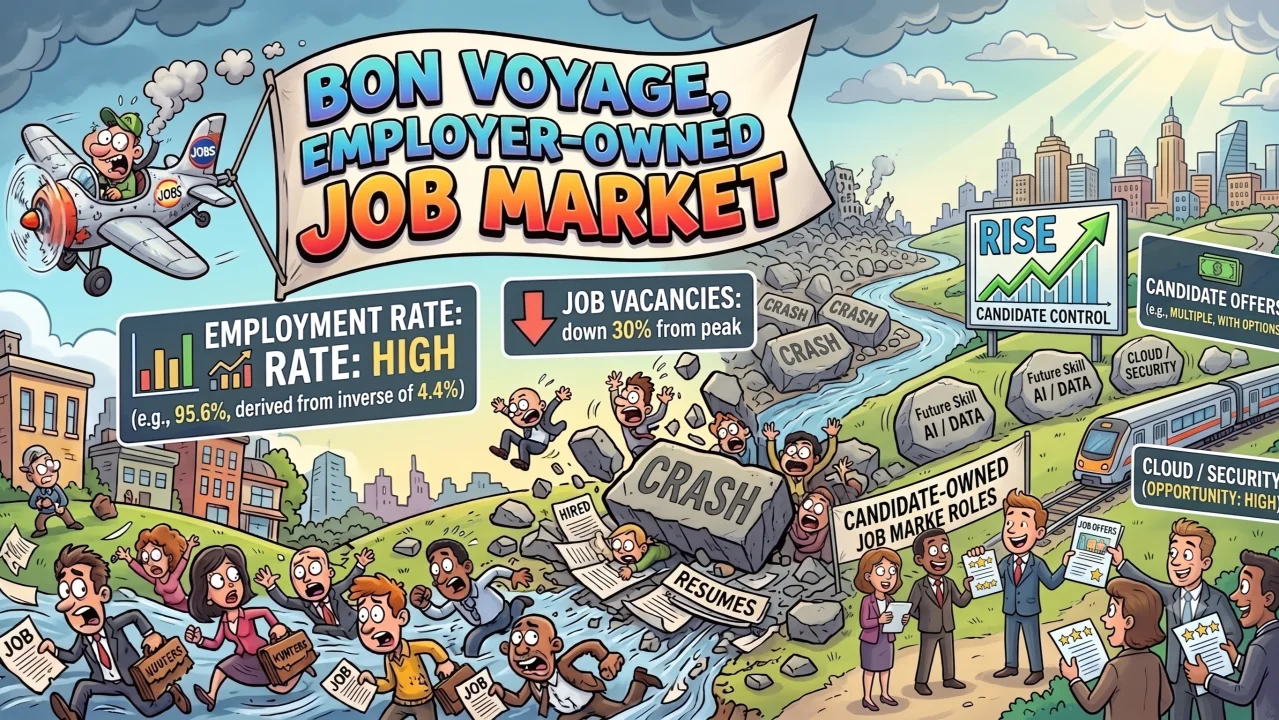
The Australian market still has jobs available. It also offers fewer vacancies than during the extraordinary hiring peak of 2022. ABS figures put vacancies at 325,000 in August 2026, 31.2% below the May 2022 peak, while still above February 2020 levels. That describes a cooler market, with conditions varying by occupation; it does not establish that AI caused the decline. 4
For someone considering a resignation, the relevant question is more specific than the national total. Are there suitable jobs within reach, with enough pay and workable conditions? An opening in another profession or another city may do little to make leaving safer.
AI adds uncertainty to that calculation, including through hiring that never happens. A role can disappear from someone's future without an existing employee receiving a redundancy notice.
An August 2026 Stanford Digital Economy Lab update found that US employment among 22-to-25-year-olds in occupations with a high share of tasks exposed to AI was about 19% below where it would have been had it kept pace with less exposed peers. The adjustment appeared to come mainly through reduced hiring. The researchers found no widespread economy-wide displacement and explicitly described the results as descriptive rather than proof of AI causation. 5
That finding points to a quieter form of pressure: fewer opportunities to get started. If employers reduce junior recruitment, people seeking experience face a harder entry, and experienced workers considering a new field may find fewer routes in. Learning new skills remains valuable, but a course cannot create a vacancy or an employer willing to offer a first chance.
The uncertainty can make an existing job feel harder to surrender, even when the person doing it is running out of energy.
Another round of redundancies
It can feel as though another restructuring announcement lands every few weeks. Individual companies do sometimes return with further cuts before employees have had much time to absorb the previous round.
Amazon announced an approximately 14,000-role reduction in its corporate workforce in October 2025, followed by reductions affecting about 16,000 roles in January 2026. Its January message explicitly addressed concern about broad cuts becoming a recurring event every few months, saying that was not the plan. 67
Block offered a more direct connection to AI. In February 2026, it announced that more than 4,000 people would leave or enter consultation, reducing its workforce from over 10,000 to just under 6,000. Jack Dorsey argued that intelligence tools made a substantially smaller team possible. The same shareholder letter reported fourth-quarter gross profit growth of 24% year on year. That is management's explanation for the decision, rather than independent proof that AI could replace every affected role. 8
These announcements should not be treated as a measure of the whole Australian economy. Australia's annual retrenchment rate actually edged down from 1.9% to 1.8% in the year to February 2026. Highly visible corporate cuts and national employment trends can tell different stories. 9
Even so, it is understandable that repeated announcements could change how someone experiences work. A profitable employer can still decide to reduce staff. Doing a good job cannot guarantee that a role survives a change in strategy.
For someone watching colleagues leave, the next planning meeting may carry more weight than its agenda suggests. They may be wondering whether another cut is coming, whether more work will fall to them, or whether this is the moment to start applying elsewhere. Keeping a job can bring relief without restoring confidence in it.
AI can save time and still increase pressure
AI has useful possibilities for workers. The International Labour Organization's 2025 assessment judged transformation more likely than wholesale redundancy across most exposed jobs, because human input remains necessary. Technological exposure is a measure of potential task change, not a count of jobs destined to disappear. 10
AI can also make work more enjoyable. OECD research in manufacturing and finance found that many workers using AI reported better performance and greater enjoyment. How an organisation introduces the technology matters alongside what the technology can do. 11
Consider a team that saves several hours each week through automation. Management could use some of that time to reduce backlogs, improve quality or give people more manageable workloads. It could also raise output targets or decide the team needs fewer people. The same technical improvement can lead to very different working lives.
Suppose a tool reduces a particular eight-hour task to three hours. That does not mean an entire job has shrunk by five hours, but it does create a choice about the saved time. More output, a shorter working day and a smaller team distribute the benefits very differently. If technology makes us more productive, why should getting some of our lives back be the outcome we discuss least?
This is where enthusiasm for AI can sit uneasily beside fear of its consequences. A worker can appreciate a useful tool while worrying about how its efficiencies will be used. Being asked to embrace change is a harder sell when the benefit to your own working life remains unclear.
Gallup research published in September 2026 linked greater anxiety about AI-related job displacement with lower job satisfaction and engagement, and higher burnout. Its US panel data followed workers over time. The association does not establish that AI itself caused those outcomes, but it shows why uncertainty deserves attention before redundancies occur. 12
An employer cannot settle that uncertainty merely by telling people to become more adaptable. Staff need a credible account of what is changing, time to learn during paid hours, and a chance to influence how new tools affect their work. Otherwise, adapting becomes another task added to an already crowded week.
The exhaustion of constantly keeping up
I wrote about information overload in 2019, in How to Avoid Information Overload, Burnout Culture & Fine-tune Work Productivity. The concern then was the constant demand on our attention: emails, messages, news, social feeds and the expectation that we could keep absorbing it all alongside a full working day. I suggested reducing notifications, taking breaks and protecting time away from screens. 13
Job insecurity can add another reason to keep checking. A new tool might matter to the next role. Another layoff announcement might signal trouble in your field. An evening spent learning can feel necessary, even when the working day has already used up your concentration.
Learning can be interesting and useful. It becomes exhausting when every unfamiliar tool feels like a threat to your employability, and rest feels like time you cannot afford to lose.
Personal boundaries still matter, but they are harder to defend when you fear falling behind. Even an evening away from learning and job-market news can feel difficult to justify.
A financial cushion can ease some of that urgency. It can give people more room to choose what deserves their attention and to take a break without feeling they are gambling with their future.
The cost of postponing a different life
The loss of financial freedom reaches beyond the workplace.
Taking time away can make room for a small business, caring responsibilities, travel or a change of direction that has been put off for years. It can also make room for rest without immediately turning that rest into a project to improve future productivity.
When every available dollar has to protect against losing a job, those possibilities become harder to pursue. The business idea stays in a notes app. The course gets deferred. Time away becomes something to consider after the next pay rise or once the market feels safer.
That produces a particular inequality. Two people can have the same ability and ambition while facing very different consequences if an experiment fails. Family support, secure housing or a partner's income can make a risk manageable for one person and unaffordable for another. Advice to take a chance often leaves those differences unstated.
AI might lower the cost of trying some ideas. Tools that help with research, drafting or software can bring a project within reach of someone working alone. Yet cheaper tools cannot pay the rent during the months before a venture earns anything. Nor do they create the energy to build it after an exhausting working day.
The freedom to venture out depends on having enough money and time for an attempt that may not work. A culture that celebrates entrepreneurship should take that practical requirement seriously.
What could a less rigid working week look like?
There are alternatives to measuring commitment through attendance. None fits every occupation, and each needs clear expectations about workload, pay and availability.
| Model | What changes | What needs agreement |
|---|---|---|
| Flexible hours | Employees have more choice over starting and finishing times. | Coverage and handovers. |
| Asynchronous work | People collaborate without always being online together. | Documentation, response times and escalation. |
| Four-day workweek | A genuinely shorter week can reduce total working hours, potentially with unchanged pay. | A sustainable workload, rather than squeezing five days into four. |
| Results-oriented work | Performance focuses on outcomes rather than attendance. | Realistic goals, quality and recognition of less visible work. |
| Core collaboration hours | A shared overlap leaves flexibility elsewhere. | Time zones and meetings kept within that overlap. |
| Project-based work | Work is organised around agreed deliverables. | Scope, payment, ongoing support and the risk of unpaid extra work. |
For cloud engineering and web development, a combination of flexible hours, written updates and measurable deliverables can be practical. Production incidents, customer commitments and on-call responsibilities still need explicit arrangements. Flexibility works better when people know who is available and when a response is actually required.
The aim should be to create room to live, not move the same pressure into a different calendar. A shorter week with impossible targets or an asynchronous team that expects instant replies can reproduce the problem under a more attractive name.
Enjoying the work is not the same as enjoying the schedule
Employment influences where we live, when we sleep, when we travel and how much time remains for people we care about. It is easy for a career to become the organising principle of a life, with meaningful freedom postponed until retirement.
I can enjoy engineering, building something useful and helping someone solve a problem while still questioning why a five-day working week should organise so much of my waking life. Wanting more control over that time does not mean lacking motivation to contribute.
A useful personal distinction is whether the work itself exhausts you, or whether it is the obligation to remain available at prescribed times regardless of the work that needs doing. Sometimes both are true. But they call for different responses: changing the tasks may help one, while changing hours, coverage or expectations may help the other.
A better test of job satisfaction
Employers should be interested in whether people would still choose their workplace if they could comfortably afford to leave it.
That question directs attention towards the conditions people experience each day: manageable work, fair pay, flexibility and some influence over decisions that affect them. A wellbeing programme has limited reach if the organisation keeps adding responsibilities without removing any.
When AI improves productivity, workers should share in the gains. That could mean higher pay, shorter hours, paid training or more time to do the work properly. Employers will make different choices, but those choices should be open to discussion with the people whose jobs are changing.
There is a wider public responsibility too. Affordable housing, accessible retraining and adequate income support can give people more room to make a transition. A society that expects workers to adapt repeatedly should care whether they can afford the period between one way of earning a living and the next.
For an individual, building savings and keeping skills current can help. But those tasks take money and energy themselves. Treating exhaustion as a personal failure to budget or prepare adds blame without addressing the conditions that make leaving so difficult.
Fuck you money, in its ordinary version, is the ability to decline a damaging situation without putting the rest of your life in immediate jeopardy. That freedom can make work more satisfying even if you never resign, because you know you have a choice.
People should be able to leave before they are completely cooked. They should also be able to stay because the job is worth choosing.
Sources
- Reserve Bank of Australia. Financial Stability Review October 2026, Chapter 2, Resilience of Australian Households and Businesses.
- Gallup. U.S. Worker Thriving Declines as Job Market Pessimism Grows. 23 March 2026; survey conducted 30 October to 13 November 2025.
- Anthony Klotz. Summary of his BBC News, The Global Story conversation with Sarah O'Connor on the Great Resignation and the Great Hunkering Down. Video published 22 June 2026.
- Australian Bureau of Statistics. Job Vacancies, Australia, August 2026. Released 1 October 2026.
- Stanford Digital Economy Lab. No Widespread Displacement, but the AI Employment Gap for Young Workers Has Widened to 19%. 12 August 2026; data through June 2026.
- Amazon. Staying nimble and continuing to strengthen our organizations. October 2025.
- Amazon. Update on our organization. January 2026.
- Block. Q4 2025 Shareholder Letter and accompanying Form 8-K. Released 26 February 2026.
- Australian Bureau of Statistics. Job mobility, February 2026. Released 31 July 2026.
- International Labour Organization. Generative AI and jobs A 2025 update. 20 May 2025.
- OECD. AI and work. Synthesis of research, including its 2023 employer and worker surveys in manufacturing and finance.
- Gallup. Using AI More Does Not Reassure Workers, Managers Do. 9 September 2026; US panel research covering 2023 to early 2026.
- Stefan C. How to Avoid Information Overload, Burnout Culture & Fine-tune Work Productivity. 14 June 2019.
- Center for Self-Determination Theory. The Theory: autonomy, competence and relatedness as basic psychological needs.
- National Museum of Australia. Eight-hour day: the 1856 Melbourne stonemasons' campaign and the movement for limits on working hours.
Thanks for reading. About reader stats
Get in touch ↗



Join the conversation
Comments and reactions use GitHub. Sign in to join in, and keep the discussion thoughtful and respectful.
View discussions on GitHub ↗