
In this article
Building a company and controlling it are different things. You can remain its public face, its largest individual shareholder and the person customers associate with its success, yet still lack the votes to determine who sits on its board.
A reader shared a Nerdiest Facebook post comparing Jensen Huang with Mark Zuckerberg. Its argument is memorable: Huang could lose his job, whereas Zuckerberg's special voting shares make him untouchable. There is a genuine governance distinction underneath that comparison, but “unfireable” is too absolute.
For me, the useful founder question is not how to become impossible to challenge. It is how to protect a long-term vision while keeping meaningful accountability when something goes wrong.
Three things founders should separate
Economic ownership concerns your financial stake. Voting power concerns decisions put to shareholders. Board authority concerns the direction and oversight of the company, including executive arrangements.
Those are related, but they are not interchangeable. Under Delaware law, the usual starting point is that a corporation's affairs are managed by or under its board's direction. Officer selection and removal depend on the governing documents and applicable rules. A shareholder vote is not required for every management decision. Delaware General Corporation Law, sections 141 and 142.
A founder with voting control may have enormous influence over who becomes a director. That does not mean the founder personally holds every power of the board, or that directors stop having responsibilities.
NVIDIA and Meta: the actual distinction
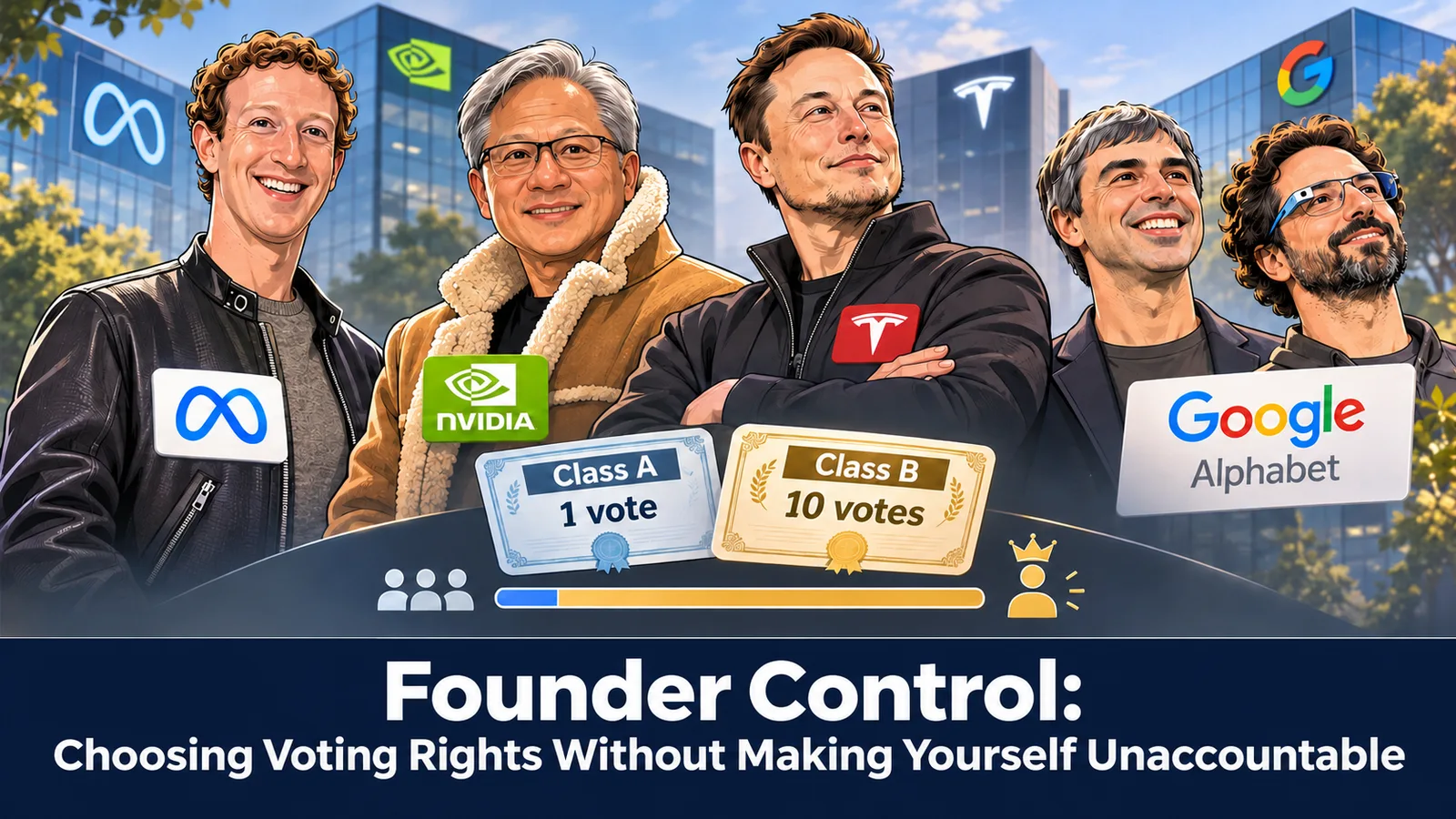
NVIDIA's 2026 proxy statement specifies one vote for each common share at its annual meeting. Being a founder does not, by itself, multiply those votes. A minority stake therefore does not automatically confer majority voting control.
Meta's structure separates those interests more sharply. Its Class A shares carry one vote each and Class B shares carry ten. Its 2025 annual report, filed in 2026 explains how that concentrates control and how transfers generally trigger conversion, subject to exceptions.
A Meta filing dated 2 November 2026 reports Zuckerberg holding 60.6% of voting power at its record date. It also discusses non-voting Class C shares and recapitalisation arrangements. That is why I would not present a viral comparison's ownership percentages as timeless facts: the date, class and denominator matter.
Control over director elections is a powerful defence against an ordinary shareholder challenge. It is not immunity from law, regulatory action or every possible route out of office. Nor does the existence of different structures prove why a particular executive departed.
Did Jensen Huang know?
I would expect a founder who had led a listed company for decades to understand its voting arrangements. NVIDIA's public proxy makes those arrangements explicit. But that is a reasonable inference, not evidence of what Huang privately thought or what advice he received.
I have not found a primary account establishing why NVIDIA originally chose this structure, or showing that Huang misunderstood it. It would be unfair to turn an explanation of shareholder rights into a claim that he overlooked a basic detail.
It would also be too simple to say super-voting shares would necessarily have prevented his departure. Legal obligations, investigations, personal decisions and commercial pressure do not disappear because someone controls shareholder votes.
A simple example of votes versus ownership
Imagine a company with 100 shares, equal economic rights and no other securities. The founder owns 15 and outside investors own 85.
With one vote per share, the founder holds 15% of the votes.
If the founder's shares instead carry ten votes each, the founder holds 150 votes and everyone else holds 85. The founder now controls 63.83% of the votes, despite owning 15% of the shares.
That example illustrates the mechanism, not NVIDIA's or Meta's actual capitalisation. Real calculations must account for outstanding classes, conversions and any other relevant rights.
Which structure fits the company you want to build?
There is no universally best arrangement. I would begin with the decisions a founder needs to protect, then examine the narrowest rights that can protect them.
| Approach | What it can help achieve | What deserves scrutiny |
|---|---|---|
| One share, one vote | A clear relationship between ownership and voting power | Control can diminish through fundraising and share sales |
| Dual-class shares | Preserve voting influence despite lower economic ownership | Entrenchment, investor objections and conversion terms |
| Negotiated board seats and voting agreements | Define representation for founders, investors and independent directors | Appointment rights, deadlocks and what changes at the next round |
| Consent rights over specified decisions | Protect particular matters without controlling every vote | Overbroad vetoes can obstruct financing or necessary change |
| Time-limited super-voting rights | Give a founder a period of protected control | The expiry date, renewal mechanism and other conversion triggers |
These arrangements can overlap. They are not a menu of universally available rights. The NVCA's model financing documents include a certificate of incorporation, voting agreement and investors' rights agreement, illustrating why the whole document set matters.
Model the next financing rounds
Do not stop at today's ownership percentage. Ask an adviser to model new investment, employee equity, conversion of existing instruments and founder share sales.
For each scenario, calculate economic ownership and votes separately. Then check who appoints directors, who can remove them, which decisions require separate approval and how a deadlock is resolved.
A founder may preserve a shareholder majority while negotiating away important approval rights. Conversely, a minority shareholder may retain a board appointment right. The cap table alone does not tell the whole story.
Decide when special rights should end
If super-voting shares are justified by a particular founder's contribution, what happens when that founder leaves, dies or transfers the shares? Should the same control continue indefinitely?
A sunset clause converts enhanced voting rights after a defined period or event. The Council of Institutional Investors advocates time-based sunsets of seven years or less. That is an investor-policy position, not a universal legal requirement.
My preference would be to ask what justifies continuing special control, rather than assuming it should last forever. Any renewal process should address whose votes count and whether the controller can effectively approve their own extension.
Preserve a credible way to challenge the founder
I understand wanting protection from investors who might sacrifice a long-term product for a short-term result. But employees and minority investors also need confidence that serious concerns can be investigated fairly.
A useful design exercise is to ask: who handles a conflict involving the founder, who selects independent advisers, and what happens if the founder disagrees with the outcome?
My engineering instinct is to avoid giving one person unlimited control while making that same person the only route to recovery. A company needs leadership continuity and a workable process for failure.
The post that prompted this article
The following post is included as the argument being examined, not as an authoritative statement of company law. Its “cannot be fired” framing overstates the protection that voting control provides. I have not relied on its unsourced IPO percentages or attributed analyst quotation.
Protect the vision, and the institution
For an early-stage founder, I would start with a straightforward structure and explicit board arrangements, then ask what concrete problem additional voting rights solve. If dual-class shares are appropriate, I would want clear conversion triggers, succession arrangements and credible independent oversight.
This is a general discussion using US companies, not a recommendation for a particular incorporation or investment. An Australian founder should have local corporate counsel assess the constitution, shareholders' agreement, fundraising plans and any intended listing venue before adopting a US-style model.
The lesson I take from the NVIDIA governance debate is that founder influence can be valuable without being unlimited. Protecting the company's mission and protecting the founder's position are not always the same thing.
Thanks for reading. About reader stats
Get in touch ↗





Join the conversation
No account needed. Keep comments thoughtful and respectful. Your first comment is held for approval.
View earlier GitHub discussions ↗