In this article
My connection to NVIDIA is personal. My memories of Windows gaming go back to a Packard Bell running Windows Me around 2000. Every dedicated GPU I owned for PC gaming was a GeForce, paired with an Intel CPU. I remember the excitement of finally being able to play Windows games, even if I can no longer pin down the exact model of that early GeForce. In 2011, I moved to a Gigabyte NVIDIA GeForce GTX 570 with 1,280 MB of GDDR5 VRAM. In 2014, I stepped away from gaming and Windows and bought an Intel Mac. These days, I use an M-series Mac.
Even Intel, the name I grew up associating with PCs, turned to outside backing for its turnaround. In August 2025, the US government agreed to provide US$8.9 billion in funding under a deal announced as a 9.9% equity stake. The deal drew on previously awarded CHIPS Act and Secure Enclave funding. SoftBank separately bought US$2 billion in Intel shares, and NVIDIA itself completed a US$5 billion share purchase that December. Intel has since reported a profit for the third quarter of 2026, but seeing the company that powered my gaming PCs take billions in backing from Washington and NVIDIA shows how much the industry has shifted. US government agreement · Intel annual report · Intel's third-quarter results
To Jensen and the NVIDIA team: thank you for those good old days of gaming, and for helping make today's AI tools possible on a global scale. I also appreciate how much AI capability I can now access through free or relatively inexpensive services, even when the infrastructure behind them is costly. That gratitude is part of why this story matters to me. It can coexist with the need for accountability.
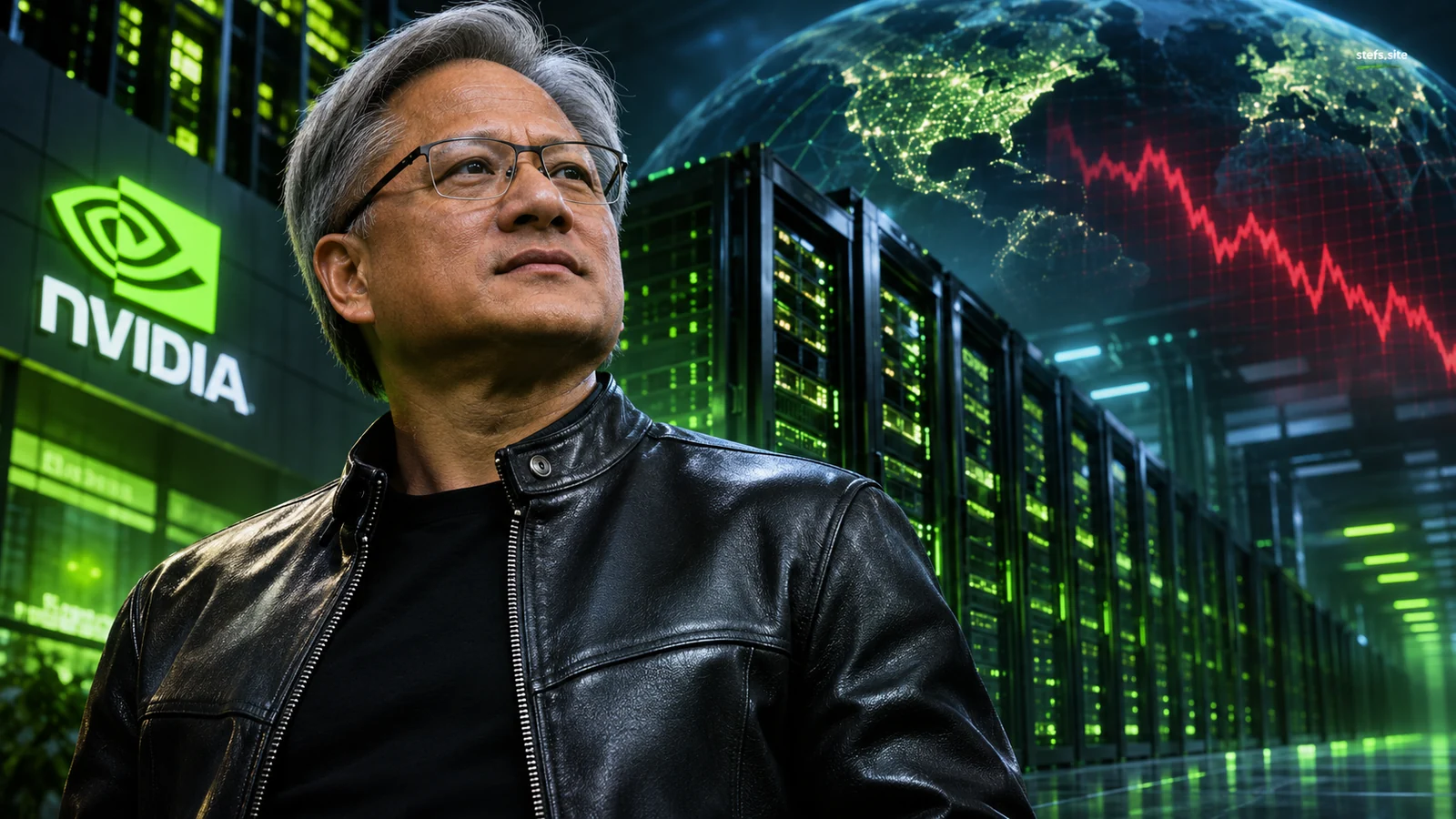
Jensen Huang helped make NVIDIA an essential supplier to the artificial intelligence boom. Then, in the space of a week, the man who had led the company since its founding in 1993 went from the public face of AI infrastructure to its most conspicuous leadership risk.
On 12 November 2026, NVIDIA announced that Huang had resigned as chief executive, president and board director, effective immediately. Finance chief Colette Kress was appointed interim CEO while retaining her CFO responsibilities, and longtime director Harvey C. Jones became the company's first-ever board chair. A search for a permanent successor began.
Shares fell sharply. In The Guardian's live coverage, NVIDIA traded at approximately US$149.79 shortly after the US market opened, more than 13% below the verified 11 November closing price of US$173.73. At that moment, the paper estimated that roughly US$888 billion of market capitalisation had been erased since the previous Friday. The shares recovered some ground during the morning. These are intraday snapshots, not final closing-price returns, and the weekly figure must not be mistaken for a one-day loss. At publication, it is already 13 November in Sydney but the 12 November US session is still open, so no closing figure for that session is available yet.
The headlines focus on alleged affairs, questions about Chinese intelligence and a suddenly vacant chief executive's chair. But the more enduring story is about an organisation of enormous strategic importance whose governance, culture and external relationships were deeply associated with one exceptionally influential individual.
BBC business editor Simon Jack described the sudden collapse of Huang's public aura, and the uncomfortable questions about NVIDIA's management that surfaced when its celebrated founder was no longer regarded as untouchable. That is the question worth investigating: had extraordinary performance allowed investors and directors to overlook extraordinary concentration risk?
And there is a human question alongside it. We can acknowledge personal failings without treating a person as though decades of achievement have ceased to exist. Equally, compassion does not absolve a board of its duty to examine conflicts of interest, security risks and the company's ability to function without its founder.
A personal scandal becomes a governance and security test
Huang publicly acknowledged being unfaithful to his wife on 8 November. His apology accepted responsibility for hurting his family and supported an independent investigation into the national-security issues raised in reporting.
The investigation followed reports of a relationship involving Alice Huang, an executive associated with Singapore-based data-centre company Megaspeed, whom US intelligence officials were reported to suspect of links to Chinese intelligence. A separate reported relationship involving a senior NVIDIA employee raised additional questions about internal power dynamics and conflict-of-interest rules.
These are separate matters with different evidentiary standards. Huang's acknowledgement of infidelity is established. Reporting about particular relationships must be attributed. A suspicion of intelligence activity is not a finding of espionage, nor is a person's nationality evidence of intelligence activity. NVIDIA's board said on 8 November that it had no reason at that point to believe national security or company secrets had been compromised. Its enquiry was ongoing, and the company's resignation announcement did not establish a completed finding of espionage.
On 10 November, independent directors announced external legal advisers for the investigation. Two days later, Huang was gone. Whether the sequence reflects decisive action as new information emerged, inadequate preparedness or some combination cannot be determined from the public chronology alone.
A board should not rush to judgement because a headline is spectacular. It also cannot treat credible security and workplace concerns as inconsequential simply because the executive under scrutiny is commercially successful.
The part we should not forget: CEOs are human
I said in response to the news that we're all human; mistakes are made. I still think that matters.
Imagine the daily pressure of leading a company whose products shape how major cloud providers, AI laboratories, manufacturers and governments plan their technology. Every product decision carries vast commercial consequences. Every geopolitical shift affects suppliers and customers. A chief executive in that position is asked to be a technical visionary, salesperson, diplomat, strategist and public symbol, often all at once.
Huang was exceptional at many of those roles. It is reasonable to believe the demands were extraordinary, even if we cannot know their full personal effect. Stress and fatigue can influence human decision-making in general, but there is no established evidence that stress, hormones, medication or any other proposed explanation caused Huang's conduct. Speculation about his private medical circumstances should not be presented as fact.
Nor should pressure be used to excuse infidelity or dismiss harm to his family. Huang himself acknowledged that harm. Workplace relationships involving reporting lines, if substantiated, raise questions that extend beyond private morality to professional obligations and the power held by senior executives.
Still, there is a wider cultural contradiction. We elevate founders as though unusual professional ability should make them immune to ordinary human weakness. We demand vision and relentless effort, then act astonished that they are not flawlessly rational in every part of life.
If we expect absolutely perfect partners, perhaps we may as well date AI. Even then, anyone who works with AI knows that a convincing answer can still be wrong.
The joke makes a serious point: perfection is not a realistic basis for human relationships or corporate design. Compassion without exoneration, and accountability without dehumanisation, is a better starting position.
NVIDIA's greatest single point of failure
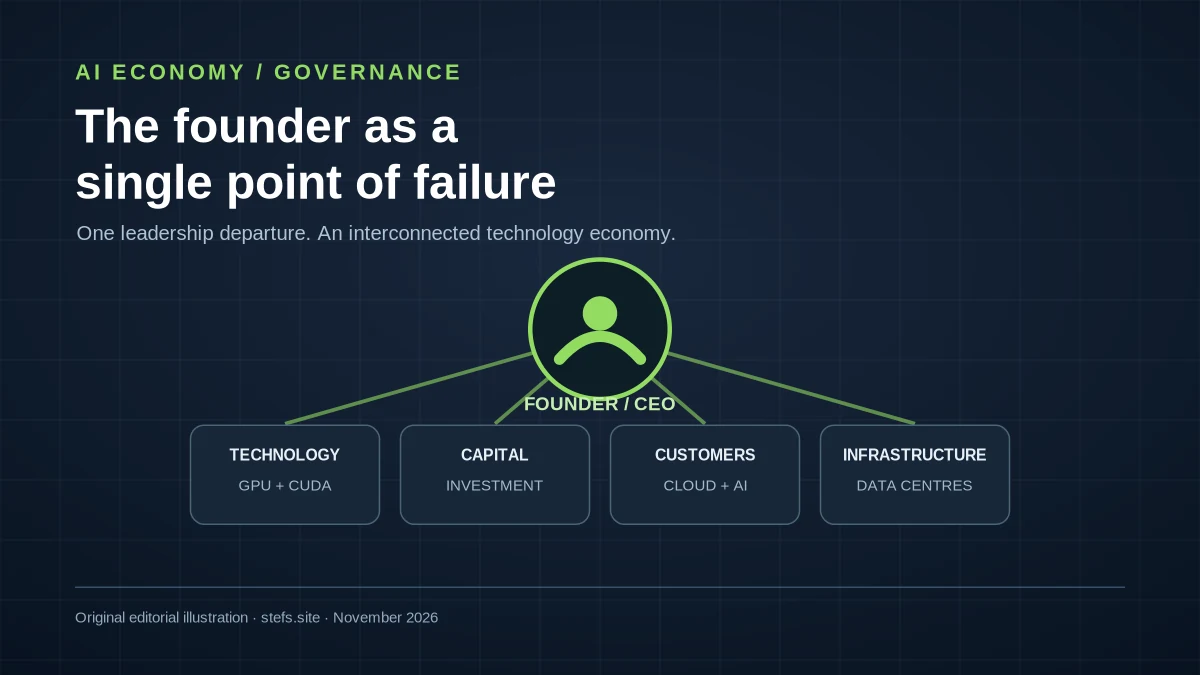
From a cloud engineering perspective, the most revealing part of this story is the organisational architecture.
Engineers routinely design for redundancy, fault tolerance, disaster recovery and high availability. We spread services across failure domains, document recovery procedures and try not to place an entire critical system behind one irreplaceable component.
Yet in many founder-led companies, institutional knowledge, authority and external relationships remain concentrated in a small number of people, sometimes principally one.
Huang ran NVIDIA with an unusually flat structure. Reuters reported that more than 60 executives reported directly to him, many occupying highly technical roles. That arrangement can be remarkably efficient when the person at its centre understands the technology and has the energy to make informed decisions quickly. It can also make succession difficult when decisions and relationships have not been distributed broadly enough.
This is the corporate equivalent of a high-performance service with a very impressive central node but insufficient failover planning. People are not interchangeable servers, of course. A successor cannot inherit trust, judgement and relationships merely by taking over a job title. That is precisely why succession has to be developed over years, not days.
In his BBC live analysis, Simon Jack argued that Huang's unusually personal leadership style had helped him build a powerful public brand, but that the scandal exposed concerns about the company's structure and oversight. His point was not that NVIDIA's technology vanished with its CEO. It was that the confidence surrounding the company had obscured questions about how resilient the institution itself was.
What about Huang's children at NVIDIA?
Jack also questioned the wisdom of family members occupying senior positions at a multitrillion-dollar public company. Reuters and other reporting identify Huang's daughter Madison in senior product marketing and his son Spencer in product management, with his son-in-law Nico Caprez also working at NVIDIA.
That is a legitimate governance topic, but it calls for precision. NVIDIA's 2026 proxy disclosures state that Huang's son and daughter do not report directly to him and that their compensation was set using the company's usual processes, without his involvement. Their roles do not, by themselves, prove improper appointments or succession arrangements.
The right question is whether the board applied transparent, consistent standards to hiring, advancement, conflicts of interest and leadership planning, including for people with close relationships to the founder.
Independent directors, but independent enough?
Before Huang's departure, NVIDIA's 2026 proxy described its directors other than the CEO as independent under Nasdaq's applicable standards, and an expansion of the board to eleven directors effective in July. It had a lead independent director and board committees with defined responsibilities for risk, compliance and governance.
Those structures matter. They are evidence that the company was not operating without formal oversight.
Yet formal independence and the practical ability to challenge an enormously successful founder are not identical. Some directors had worked with Huang for decades. Such relationships can provide institutional memory and technical insight, but they can also create familiarity and hesitation when the CEO's conduct itself becomes an issue.
The board faced a difficult decision. Preserve continuity around a leader whose judgement had created immense shareholder value, or accept the uncertainty of his departure while an investigation continued. Neither choice guarantees an immediate market reward.
A tumbling share price does not automatically prove that directors failed. Nor does a recovery automatically vindicate their earlier oversight. Governance should be judged by the independence of the investigation, the fairness of the process, the consistency of conduct standards and the credibility of succession planning.
Kress's interim appointment provides valuable continuity: she joined NVIDIA as CFO in 2013 and knows its finances and investors. But the combined CEO/CFO responsibilities are substantial. The decision to name Jones the first-ever chair also changes the board's structure at a moment when directors have to demonstrate genuine oversight rather than merely reassure markets.
The organisation now needs to show that its product roadmap, supplier relationships and strategy are institutional capabilities, not just reflections of Huang's personal presence.
He left the boardroom, but not necessarily his NVIDIA investment
Huang's resignation is more comprehensive than stepping down as CEO: NVIDIA confirmed that he also left the presidency and the board, effective immediately. That does not mean his shares were automatically sold, cashed out or returned to the company. Ownership of shares is separate from employment, and existing shares can remain with a former executive. Any unvested performance awards are a different matter, governed by their terms and any departure arrangements that have not been publicly detailed.
The scale of his continuing economic connection is significant. In NVIDIA's May 2026 proxy statement, Huang was reported as beneficially owning 870.6 million shares, or 3.58% of the company, as of 23 March. That figure includes family trusts and a charitable foundation, rather than shares all held personally or freely available to sell. One living trust held 528.5 million shares, with Jensen and his wife, Lori, named as co-trustees. The filing expressly says neither has a personal economic interest in the shares held by their foundation. His holdings may have changed since that disclosure.
Could concern about a divorce have accelerated the board's decision? There is no verified public indication of divorce proceedings or evidence that a potential property settlement drove the resignation. Under California's general community-property rules, a divorce can involve an equal division of qualifying marital assets, including shares, not an automatic claim to half of NVIDIA. Trust structures, separate property and any agreements would make an actual division much more complex. A hypothetical settlement would concern the couple's assets, not require NVIDIA itself to pay out half its value.
The more immediate and documented pressures on the board were the independent security investigation, reported workplace-governance concerns, reputational damage and market uncertainty. NVIDIA has not publicly established the directors' precise reasons for the transition, so those factors should be described as plausible considerations rather than proven motives. Removing an iconic founder could itself intensify the sell-off; protecting long-term corporate integrity and keeping a share price elevated for the next trading session are not the same objective.
The distinction also keeps the Steve Jobs comparison in perspective. Huang could remain financially invested in NVIDIA and theoretically return in some future capacity, even without an executive or board role today. There is no announced plan for a comeback, but leaving an office is not the same as severing every tie to the enterprise one built.
The AI economy's circular-financing question
The BBC segment raises another, arguably more systemic, concern: NVIDIA is not merely supplying the AI economy. It also invests in companies, supports infrastructure projects and participates in financing arrangements intended to stimulate AI deployment.
NVIDIA's fiscal 2026 annual report recorded approximately US$215.9 billion in revenue, including around US$193.7 billion from its data-centre business. Two direct customers accounted for 22% and 14% of annual revenue, a combined 36%, though direct purchasers are not necessarily the ultimate end users of the chips.
That already demonstrates substantial concentration on both sides of the market: NVIDIA depends on large buying channels; cloud providers, AI developers and data-centre operators depend heavily on NVIDIA's hardware and software.
The financing arrangements add another layer. In August 2026, NVIDIA announced partnerships with Apollo, BlackRock, Blackstone, Brookfield, Goldman Sachs and KKR intended to mobilise more than US$500 billion of third-party capital over time for AI infrastructure. That figure describes a financing initiative, not US$500 billion already deployed or an unconditional guarantee.
The company's quarterly filing also disclosed substantial ecosystem investments and commitments. NVIDIA argues that such arrangements broaden access to computing, support customers with real demand and can be independently underwritten. Critics worry about circular financing: suppliers, customers, investors and infrastructure financiers becoming so closely interconnected that weakness in one part of the system damages confidence elsewhere.
Consider the feedback loop. A GPU supplier invests in or supports an AI infrastructure business. That business raises capital to buy GPUs and rent compute. AI developers use the compute, sometimes backed by investors whose returns depend on further AI adoption. If end-user demand disappoints or financing costs rise, several links in the chain may come under pressure together.
This does not establish that the investments are artificial or unsustainable. Cloud infrastructure has always required expensive capital investment, and long-lived equipment is frequently financed. The relevant question is whether demand, utilisation and cash flow justify the commitments, and how clearly investors can identify where the risk ultimately sits.
Huang's departure does not sever those arrangements overnight. But a change in strategic leadership may alter future risk appetite, capital allocation and the balance between supplying computing technology and financing the customers who purchase it.
It is exactly the sort of complex, cross-company dependency a responsible board should model before a crisis.
The stock-market sell-off: a warning, not a verdict
The immediate market response was extraordinary in scale, but its interpretation requires care.
As noted above, The Guardian recorded an early-session decline exceeding 13% on 12 November. It estimated a loss of roughly US$888 billion in market capitalisation since the previous Friday at that point in trading. Later in the morning, the stock had recovered to a smaller decline.
Market capitalisation is the share price multiplied by shares outstanding. A decline does not mean that the equivalent amount of cash has left NVIDIA's balance sheet, that its engineers have forgotten how to design GPUs or that its production capacity has suddenly disappeared.
Prices are forward-looking. Investors were repricing uncertainty: who makes strategic decisions next, whether large customers retain confidence, whether regulators change course, and whether the board can provide a credible succession path.
Near-term orders may remain intact even while the market questions the next three to five years. The real indicators to watch are product execution, customer capital expenditure, software adoption, manufacturing capacity, executive retention and the outcome of the investigation.
That distinction becomes even more important when comparing NVIDIA with an online meme about executives' affairs.
The viral claim: 'CEO affair = bullish'
A Facebook reel from Ericnomics compares several technology-company stock charts after relationship controversies became public. It features Jeff Bezos, Bill Gates, SK Group chairman Chey Tae-won, Sergey Brin and Jensen Huang, under the deliberately provocative premise that executive-affair headlines are followed by rising share prices.
A reconstruction by The Breakdown reports these subsequent price returns through 6 November 2026:
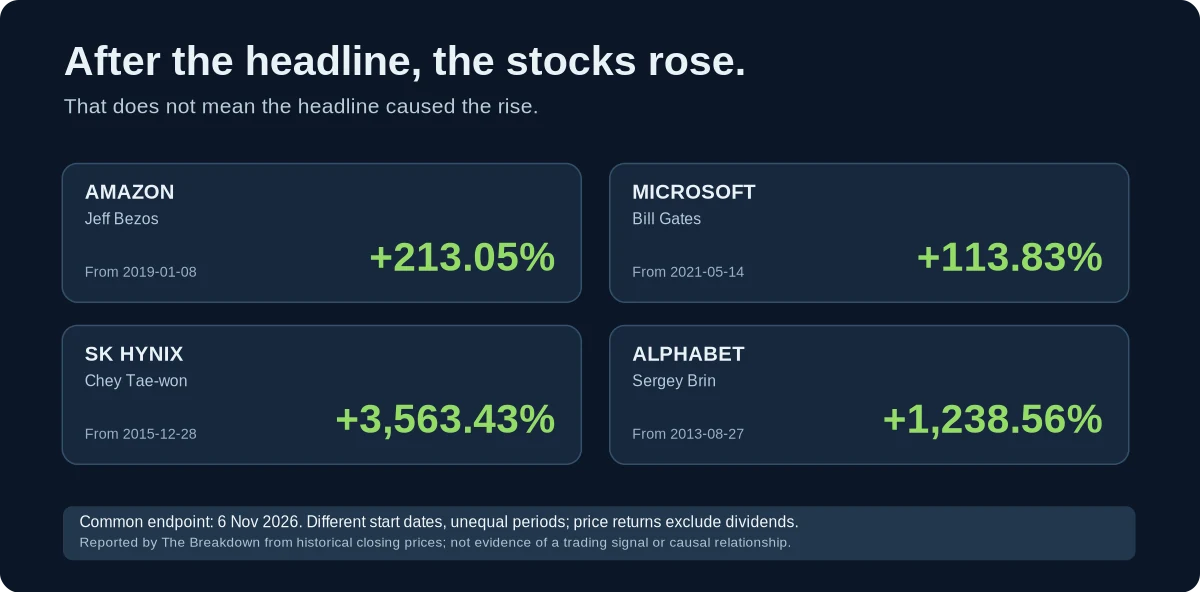
For readers using a screen reader or a smaller screen, here are the same comparisons in text. Each ends at the 6 November 2026 close:
- Amazon: US$82.829 on 8 January 2019 to US$259.30, +213.05%. Price history.
- Microsoft: US$248.15 on 14 May 2021 to US$530.61, +113.83%. Price history.
- SK hynix: ₩30,900 on 28 December 2015 to ₩1,132,000, +3,563.43%. Price history.
- Alphabet Class A: about US$21.275 on 27 August 2013 to US$284.78, +1,238.56%. Price history.
Calculations use unrounded, split-adjusted closing prices and exclude dividends. They verify the arithmetic, not the meme's causal interpretation.
These gains are striking, but the comparison is not an event study. The starting dates vary from 2013 to 2021. The returns exclude dividends. The SK hynix figure is measured in Korean won. Comparing years of appreciation with NVIDIA's movement over hours is not remotely like-for-like.
There are also important differences in who actually ran the companies.
Sergey Brin was a Google co-founder and influential executive when reports of his 2013 relationship with Amanda Rosenberg emerged, but Larry Page was CEO. Alphabet's later growth reflected advertising, YouTube, mobile computing, cloud services and other business factors.
Bill Gates acknowledged a past relationship with a Microsoft employee in 2021, long after he had stopped serving as CEO. Microsoft was being led by Satya Nadella, with Azure and enterprise software among its major growth drivers. The company's subsequent share-price gains cannot be attributed to Gates's private conduct.
Jeff Bezos was still Amazon's CEO when his relationship with Lauren Sánchez became public in 2019. Amazon continued growing through AWS, e-commerce, advertising and logistics, and Bezos later handed the CEO role to Andy Jassy. Those outcomes demonstrate organisational continuity, not a causal benefit from the controversy.
Chey Tae-won was chairman of SK Group, the parent conglomerate, not CEO of SK hynix. Memory-chip demand, company performance and a far longer measurement period matter much more to explaining the chart than the fact of a relationship disclosure.
Elon Musk illustrates how a charismatic founder can remain tightly associated with a company's valuation, though personal allegations concerning him differ in evidentiary status. For example, Musk denied the reported relationship with Nicole Shanahan. Tesla's stock has experienced substantial rallies and reversals, influenced by factors ranging from electric-vehicle demand to autonomous-driving expectations, rather than any demonstrated 'affair premium'.
There is a useful counterexample at Intel. In 2018, CEO Brian Krzanich resigned after the board found that a previous consensual relationship violated its non-fraternisation policy. The point is not that Intel's later fortunes were caused by that resignation. It is that an organisation had to enforce a conduct rule and manage succession despite uncertainty.
The VnExpress overview of technology billionaires' scandals provides additional historical context, although individual allegations and denials must be preserved rather than collapsed into a single category.
Markets do not reward infidelity. They reward expectations of sustainable earnings, adjusted for risk. Personal controversies can change those expectations, but a chart rising afterward is not proof of why it rose.
The meme's NVIDIA chart has another crucial flaw for this comparison: its cutoff was 6 November, before Huang's acknowledgement on 8 November and resignation on 12 November. It cannot tell us what happened after those events.
Watch the original reel
Could Elon Musk or another semiconductor group recruit Huang?
Another intriguing possibility emerged when Elon Musk responded to an online suggestion that he hire Huang. Musk's reply was short: 'That would be an honor.' It was reported by Bloomberg and other outlets. It was an expression of interest, not a confirmed employment offer, and he named no role or company.
That reaction is a reminder that industry expertise does not evaporate when a leader leaves a post. Huang spent 33 years developing relationships across semiconductors, cloud computing and AI infrastructure. His experience could be valuable elsewhere, even if contractual, governance or reputational factors complicate the possibilities.
Taiwanese semiconductor firms are another speculative possibility given the island's central position in chip manufacturing. A mainland Chinese company attempting to recruit someone with Huang's knowledge would raise quite different questions, especially around US export controls, confidentiality, intellectual property and national security. There is no verified offer from either Taiwan or mainland China.
A Facebook group discussion shared by readers and accompanying social graphics reflect this speculation, but should not be mistaken for an announcement from any prospective employer.
The historical analogy is Steve Jobs, whose departure from Apple in 1985 did not end his contribution to computing; he founded NeXT and eventually returned to Apple. It is a useful illustration of how a founder's professional story can outlast a particular corporate role, not a prediction of Huang's future.
A crisis amplified by AI misinformation
The social-media material supplied for this article includes a post concerning a purported family statement. I have not independently authenticated that statement, or established whether any accompanying media are genuine, manipulated or AI-generated. Without a verified primary source, a supposed statement from Huang's daughter should not be repeated as genuine. An unverified clip is not evidence of what a family member believes.
A Facebook post shared during the discussion and an earlier X post about the unfolding allegations are linked here for transparency about the public conversation, not as independently verified evidence. Social posts may be removed, restricted or inaccessible without an account.
This is another irony for the AI economy: synthetic content can accelerate confusion around the very companies supplying the computing infrastructure used to produce it. The appropriate response is not to amplify every viral clip but to check provenance, distinguish allegation from evidence and respect the privacy of people drawn into the story.
What happens next will matter more than what happened this week
NVIDIA is a company with deep engineering talent, major customer commitments, established software platforms and extensive supplier relationships. Its advantages did not disappear when the CEO changed.
The real resilience test will play out over quarters and years. Can Kress and a permanent successor maintain product execution, customer confidence and the company's formidable software ecosystem? Can the board demonstrate consistent oversight and credible leadership depth? Will AI infrastructure projects be financed by sustainable usage and revenue, rather than expectations of the next funding round? And will regulators find any evidence requiring action beyond the governance response already under way?
NVIDIA's scheduled 17 November 2026 earnings announcement will provide an early financial checkpoint, but one quarter cannot answer these questions. Nor can a few trading sessions establish whether its valuation has permanently changed.
There may even be a constructive outcome: a more mature, distributed governance structure could make NVIDIA more credible and less dependent on the founder premium that once appeared to be an unqualified asset.
In my earlier piece, The Cloud Keeps Breaking. So Why Are Tech Workers Still Being Laid Off?, I examined the gap between the importance of digital infrastructure and the way we manage the people who keep it operating. This is a related mismatch. We insist on resilient systems, but too often tolerate fragile organisational structures when their leaders are producing spectacular returns.
Huang's achievements deserve recognition. His family deserves privacy. Substantiated misconduct should have consequences. Unproven intelligence allegations should not be promoted into convictions by headlines or social media. And corporate boards should plan for a simple truth that applies to every executive, however visionary: human beings are fallible.
NVIDIA helped teach the world to build powerful AI infrastructure. Its next challenge is to demonstrate that the company behind that infrastructure is strong enough to thrive without the person who built it.
The ultimate test of an exceptional founder's legacy may not be how indispensable he became, but whether the institution can succeed without him.
Sources and the original posts discussed
Primary documents and reporting
- NVIDIA: CEO transition announcement, 12 November 2026
- NVIDIA: Jensen Huang's message to employees, 8 November 2026
- NVIDIA: Board statement on independent investigation
- NVIDIA: Independent directors' update
- NVIDIA: Fiscal 2026 annual report
- NVIDIA: 2026 proxy statement
- California Courts: property and debts in a divorce (community and separate property)
- NVIDIA: August 2026 AI infrastructure financing announcement
- NVIDIA: Fiscal 2027 Q2 filing, financing disclosures
- BBC live: Simon Jack's analysis of Huang and NVIDIA's governance
- BBC/Reuters photograph of Jensen Huang accompanying the live coverage, linked for reference, not copied or rehosted.
- The Guardian: live coverage of resignation and market reaction
- Reuters: Huang's departure and AI industry implications
- VnExpress: relationship controversies involving technology billionaires
- The Breakdown: source dates and calculations behind the viral stock charts
- Bloomberg via The Edge: Musk's expression of interest
Social-media posts supplied during the discussion
- Original X post that prompted the discussion, commentary/source of discussion, not verification of the allegations.
- Facebook post concerning a purported family statement, contents and authenticity unverified; not used as factual evidence.
- Ericnomics Facebook reel: historical stock-price comparisons, included as an embedded, critically examined social-media argument.
- Facebook group post about a potential Musk/Huang role, discussion of possibilities, not a verified offer.
Editorial note: Prepared using information available on 13 November 2026 (Australia/Sydney time). The 11 November US close is the verified baseline. The 12 November US session was still open at publication, so that day's prices and market-capitalisation estimates are explicitly intraday. Allegations of intelligence activity and other disputed claims are not established findings. The original illustrations are newly created for this article; BBC/Reuters photographs and third-party social-media screenshots are linked or officially embedded, not republished as owned assets.
Thanks for reading. About reader stats
Get in touch ↗


Join the conversation
No account needed. Keep comments thoughtful and respectful. Your first comment is held for approval.
View earlier GitHub discussions ↗