The ATS Trap: How HR Engineered Its Own Irrelevance and How to Fix It
What the Bolt story tells us, what the data confirms, and what IBM, Block, and Target add to the picture
Last week, Bolt CEO Ryan Breslow made headlines at Fortune's Workforce Innovation Summit with a blunt admission: he fired his entire HR department. His reasoning was direct: "We had an HR team, and that HR team was creating problems that didn't exist. Those problems disappeared when I let them go."
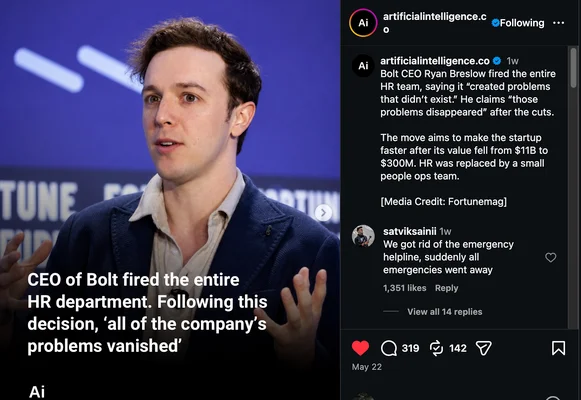
Bolt CEO Ryan Breslow comments on firing his entire HR department.
Bolt CEO Ryan Breslow On Why He Eliminated HR (view original embed)
Bolt is a cautionary tale on multiple levels. A company whose valuation fell from $11 billion in 2022 to roughly $300 million by 2024, now executing a brutal reset with a lean team of about 100 people. Breslow is operating in what he calls "wartime." He scrapped four-day work weeks, unlimited PTO, and most controversially, the entire HR function. In its place sits a smaller "people operations" team focused on training and compliance. On LinkedIn, he was unapologetic: "HR is the wrong energy, format, and approach. People ops empowers managers, streamlines decision-making, and keeps the company moving at lightning speed."
Many in the HR community will read this as an extreme outlier, a stressed founder lashing out under financial pressure. And they would be partially right. Breslow's turnaround involved cutting 30% of headcount, scrapping perks he himself championed, and operating under circumstances most organisations will never face. It is not a blueprint.
But it would be a mistake to dismiss it entirely. Because Breslow's frustration is not unique. It is the loudest, most public articulation of something a growing number of business leaders, hiring managers, and job seekers have been quietly feeling for years. And much of that frustration traces back to one thing: the systematic misuse of Applicant Tracking Systems.
The Tool That Became the Strategy
Applicant Tracking Systems were designed to solve a genuine problem. At scale, manually reviewing hundreds of applications per role is unmanageable. ATS platforms brought structure, searchability, and speed to a process that desperately needed all three. Used well, they are a genuine asset. Companies using ATS report up to 40% lower turnover in new hires compared to those without.
But somewhere along the way, the tool became the strategy. Rather than using ATS to organise the hiring process, many organisations began using it to define the process, outsourcing human judgement to a keyword engine and calling it efficiency.
The consequences have been well documented. A landmark 2021 Harvard Business School study titled Hidden Workers: Untapped Talent found that 88% of employers believed their ATS was weeding out high-skilled candidates because those candidates' resumes did not precisely match the system's configured criteria. More damning still: 90% of executives acknowledged that their hiring process was eliminating qualified candidates, and were continuing to use the same systems regardless.
Let that land for a moment. Nine in ten executives knew their system was rejecting good people, and kept running it anyway.
The Harvard researchers identified more than 10 million workers in the US alone being systematically excluded by ATS screening practices, not because they lacked the skills, but because their resumes did not tick the right boxes in the right format.
This is not a fringe issue. Over 99% of Fortune 500 companies and the vast majority of mid-sized employers now use ATS in their hiring process. That means the misconfiguration problem, when it exists, operates at enormous scale.
The Specific Ways ATS Configurations Fail
To be direct: the technology itself is not the villain. Poorly configured, under-audited, and unaccountable ATS deployments are. The failure modes are specific and repeatable.
1. Keyword matching without semantic understanding
An ATS configured to filter for "cloud infrastructure" may discard a strong candidate who consistently wrote "AWS architecture" throughout their resume. The human meaning is identical; the parser sees a mismatch. Traditional ATS systems rely on rigid keyword matching, rejecting qualified candidates who describe their experience differently. Without regular auditing of filter criteria, these mismatches compound silently across every hiring cycle.
2. Formatting as a qualification
Research shows that 25% of ATS systems fail to properly read contact information stored in document headers and footers. Tables, text boxes, multi-column layouts, and creative section headings, design choices that would impress a human reviewer, cause ATS parsers to scramble or skip content entirely. The result is that a candidate gets penalised for producing a well-designed, readable document. The system is filtering for compliance with its own quirks, not for quality of experience.
3. Knockout questions with no override mechanism
Blanket hard filters such as "must have a degree," "must have 5 years in X," and "no employment gaps longer than 6 months" remove nuance from a process that fundamentally requires it. The Harvard HBS study found that 49% of companies eliminated candidates with employment gaps of six months or longer, a criterion that disproportionately affects caregivers, people returning from illness, and those who took calculated career breaks. A hiring manager who might have made an exception, and found an outstanding hire, never gets the opportunity.
4. Degree inflation baked into filters
A separate Harvard and Burning Glass Institute study on skills-based hiring found that despite widespread public commitments to removing degree requirements, skills-based hiring translated to change in fewer than 1 in 700 actual hires. Companies updated their job postings and left their ATS configurations unchanged. The filter did the discriminating quietly, at scale, while leadership announced progressive hiring policies publicly.
5. No feedback loop on what the system is discarding
Most ATS deployments lack any systematic review of what they filter out. HR teams see what passes through; they rarely examine what was discarded. Without that review, there is no mechanism to detect misconfiguration, credential bias, or the slow drift between what a filter was designed to catch and what it is actually catching. The system runs in the dark.
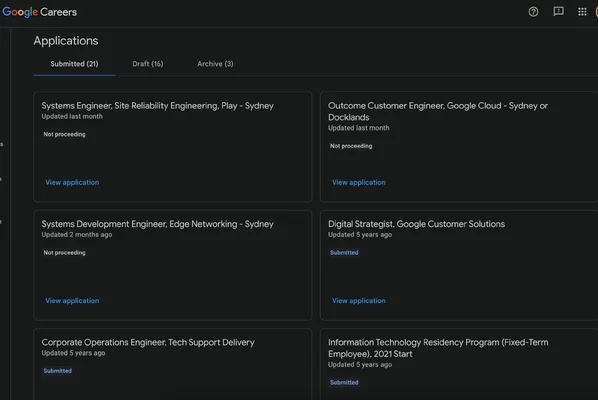
How a typical ATS looks like, this one gives some minor feedback as to whether an application is proceeding or not, some do show this status but it's quite not useful information for job applicants.
6. Set-and-forget configurations
Job requirements shift. Skill landscapes evolve rapidly. But ATS configurations, once built for a role, frequently persist unchanged across multiple hiring cycles and years. Criteria that made sense during a different talent market, or for a slightly different version of the role, quietly eliminate the best candidates available today.
The Candidate Experience Nobody Talks About
There is a downstream effect to all of this that HR discussions rarely surface: what it does to the talent market's perception of your organisation.
When candidates apply to a role, receive an automated rejection within minutes, or silence for weeks, and never hear from a human, they draw conclusions. In an era where 92% of job seekers never complete their applications and 69% of applicants won't accept a job offer if the company takes too long to respond, the experience is the employer brand.
Experienced professionals, particularly those returning from career breaks, those with non-linear career paths, or those who write thoughtfully rather than keyword-stuff, are systematically disadvantaged. Over time, they stop applying. Word spreads. The candidates who do make it through the ATS filter are increasingly those who have optimised their resumes for parsers, not those who are necessarily the best fit for the role.
You end up hiring people who are good at getting past your ATS. That is a very different quality from being good at the job.
What "People Ops" Is Actually Saying
Breslow's decision to replace HR with a leaner "people operations" function is not just semantics. It reflects a broader executive frustration with HR teams that became process-centric rather than outcome-centric, departments generating internal complexity rather than resolving it.
The same critique applies directly to ATS practice. When HR measures success by applications processed rather than quality of hires made, when the goal becomes keeping the funnel moving rather than finding the right people, the system is optimising for the wrong thing entirely.
This is not an argument for eliminating HR. Eliminating HR does not fix broken hiring. It just removes accountability for it. The organisations that have gone furthest down the "no HR" path tend to rediscover why HR exists when employment disputes, compliance failures, or cultural breakdowns arrive.
What the Bolt episode is an argument for is HR reclaiming its core purpose: being the function that ensures the organisation finds, develops, and retains the right people, and that the technology it deploys serves that purpose rather than substituting for it.
The Broader Pattern: Bolt Is Not Alone
Bolt is the loudest example, but it is not an isolated one. Across the industry, companies are making very different choices about what to do with HR functions, and the contrast is instructive.
Recommended by LinkedIn
[
AI in HR news, week 20-21 - 2026
Rick Weijers 4 months ago
](https://www.linkedin.com/pulse/ai-hr-news-week-20-21-2026-rick-weijers-ds5ze)
[
Developments in HR: The future of recruitment, current…
Patrik Reman 4 years ago
](https://www.linkedin.com/pulse/developments-hr-future-recruitment-current-trends-challenges-reman-1c)
[
Rethinking HR Tech: Building What Works for People
Bobby Kimani 1 year ago
](https://www.linkedin.com/pulse/rethinking-hr-tech-building-what-works-people-bobby-kimani-jctjf)
Block (Jack Dorsey): The AI displacement wave
In February 2026, Jack Dorsey cut 40% of Block's workforce, going from over 10,000 employees to under 6,000. The rationale was explicit: AI tools had changed the economics of building and running the company. Unlike Bolt, Dorsey did not single out HR specifically. The cuts swept across the organisation. He framed it not as a crisis response but as a deliberate strategic choice, saying he would rather take one hard, clear action than repeated smaller rounds of cuts that destroy morale and trust.
Block's story is less about HR failing and more about the broader question every people function needs to be asking right now: which parts of what we do are genuinely strategic, and which parts are administrative tasks that AI can now handle faster and cheaper?
IBM: The counter-narrative worth studying
IBM took a very different approach, and it is the most instructive example for HR professionals. IBM replaced approximately 200 HR roles with its AskHR AI agent, which now handles over 1.5 million employee conversations annually, covering routine requests like payroll queries, vacation requests, and policy clarifications. IBM's CTO confirmed the agent automated 94% of simple, routine HR tasks and contributed to a $3.5 billion productivity improvement across the business over two years.
Critically, IBM's total headcount went up, not down. The savings freed up investment to hire in areas where human judgement genuinely creates value: strategy, client work, engineering, and innovation. IBM did not eliminate HR. It eliminated the administrative layer of HR and redeployed human talent toward work that machines cannot do well.
That is the model worth watching. Not "fire HR" and not "protect HR from scrutiny." Transform it deliberately, before someone else forces the conversation.
Target: Caught in the efficiency crossfire
Target cut 1,800 corporate roles in October 2025, with HR among the functions affected, as part of a broader simplification effort aimed at speeding up decision-making. Target did not make a specific argument about HR's failings. HR was simply included in the broader rationalisation of corporate overhead.
This pattern, HR being caught in headcount reduction exercises without a specific case for its value, is arguably the most common and most preventable version of this story. When HR cannot articulate its impact in business terms, it becomes part of the overhead problem rather than part of the solution.
Practical Ways Forward
If you are in HR, recruiting, or people leadership, the right response to all of this is not defensiveness. It is a clear-eyed audit of where your function is genuinely delivering value and where it is not. Here is where to start.
Audit your knockout criteria now, not at the next hiring cycle
Pull your current ATS configurations for your three most commonly filled roles. Ask who set these criteria, when, and based on what evidence. Are the hard filters truly non-negotiable, or are they accumulated assumptions? Degree requirements, experience year minimums, and employment gap filters deserve particular scrutiny. If you cannot articulate why a filter is a hard knockout rather than a soft signal, it probably should not be one.
Build a regular discard review process
Sample a percentage of ATS-rejected applications each month and have a human recruiter or hiring manager review them. This is the only reliable way to detect when a filter is misconfigured, outdated, or producing unintended bias. It also creates a feedback loop that makes future configuration decisions evidence-based rather than intuitive. Many modern ATS platforms including Workday, Greenhouse, and Lever have reporting capabilities that make this more tractable than it once was. Use them.
Separate formatting compliance from candidate quality
If your ATS is rejecting candidates based on formatting rather than substance, that is a configuration problem, not a candidate quality problem. Work with your ATS vendor or internal configuration team to ensure the parser is as format-tolerant as possible, and consider whether your application guidance to candidates is clear enough about submission requirements. Many ATS systems now offer improved parsing capabilities, but only if they are correctly configured and updated.
Make job requirements honest
The most common driver of ATS misconfiguration is inflated job requirements. If a role genuinely needs five years of experience, filter for it. If it is aspirational, posted as a senior role when an intermediate hire would succeed, the filter is eliminating your actual candidate pool while you wonder why no one suitable is applying. Harvard Business School's research recommends updating job descriptions more regularly to reflect genuinely essential skills, while eliminating superfluous qualifications that have accumulated over time.
Use ATS data to measure outcomes, not just throughput
Track the source-to-hire quality of candidates who pass through ATS screening. If your ATS-filtered hires are leaving faster, underperforming against expectations, or consistently requiring longer ramp times, that is a signal worth investigating. It may indicate the filter is selecting for the wrong qualities. Mondo's hiring research consistently finds that outdated ATS filters do not just eliminate candidates. They eliminate the best candidates, who have more options and less tolerance for frustrating application processes.
Invest in the human touchpoints ATS cannot replace
Reintroduce structured human review at key screening stages, particularly for roles that are hard to fill or strategically important. Ensure candidates receive timely, meaningful communication rather than just automated status updates. The human element that made HR valuable in the first place, the ability to read context, exercise judgement, and advocate for unconventional candidates, does not disappear because an ATS exists. It just needs to be deliberately preserved.
Take the IBM lesson seriously
IBM's approach offers a practical template. Identify which parts of your HR function are genuinely transactional: answering repeat policy questions, processing standard requests, scheduling interviews, sending status updates. These are legitimate candidates for automation. Then redirect the human capacity that frees up toward the work that actually requires people: building hiring manager capability, improving candidate experience, making better decisions at the margin, and advocating for talent that does not fit neatly into a filter.
Close the gap between skills-based hiring rhetoric and actual configuration
If your organisation has announced a commitment to skills-based hiring but has not updated its ATS configurations to match, you have a gap between policy and practice that will eventually surface. The Harvard and Burning Glass research found that 45% of firms pivoted to skills-based hiring in name only, changing job postings but not hiring behaviour. Do not be one of them.
The Bigger Picture
The organisations that will win the next decade of talent competition will not be the ones with the most sophisticated ATS. They will be the ones where HR has the credibility, the data literacy, and the executive support to keep technology accountable to human outcomes.
The contrast between Bolt and IBM is the sharpest possible illustration of the fork in the road. One company reached a breaking point and eliminated the function. The other transformed it deliberately, automated the transactional layer, and redeployed human talent toward higher-value work. The outcomes could not be more different.
ATS platforms, used well, are genuinely powerful. They reduce administrative burden, improve consistency, and when properly configured, surface strong candidates faster and more fairly than unstructured human review. The technology is not the enemy. The absence of human accountability around it is.
The Bolt story is a warning. The Block and Target stories are a reminder that this pressure is not going away. The IBM story is the clearest signal of what good looks like.
HR's job now is to make sure the answer to the question every CEO is quietly asking is never in doubt. Are our systems serving our talent strategy, or have they become the strategy by default?
That answer starts with honest scrutiny of your ATS configuration, and it starts today.
If you liked this, please consider subscribing to Resuleet - a job application automation platform designed to be better and simpler. Agent to Agent applications will eventually take over, we want to be ready for that.

[
Stefan C.
Influencer
📃Resuleet.com – Auto-apply Job Apps | AI Product Developer | 15y+ Cloud/Systems Engineer⛅️ | Public & Private-Sector Hiring | Ex-AWS • GCP • Azure | Platform Engineer • WordPress |🌏stefs.site | Publisher | Meetup Buddy
8,498 followers
](https://www.linkedin.com/in/stefancaliaro)[
Follow
](https://www.linkedin.com/in/stefancaliaro)
If you're a job seeker, you might want to read this ex-meta story below or some of my other articles.
What has your experience been, either running an ATS deployment or navigating one as a candidate? I would be interested in what is working and where the gaps are. Drop a comment below.
Sources and further reading:
- Fortune: Bolt CEO says HR was "creating problems that didn't exist"
- Fortune: Jack Dorsey on laying off 40% of Block's staff
- Entrepreneur: IBM CEO confirms AI replaced hundreds of HR roles
- Harvard Business School: Hidden Workers: Untapped Talent
- Harvard Business School: How to Tap the Talent Automated HR Platforms Miss
- Harvard / Burning Glass: Skills-Based Hiring: The Long Road from Pronouncements to Practice
- HR Executive: "HR is the wrong energy": Bolt CEO defends eliminating the department
- Tracker RMS: Applicant Tracking System Statistics 2026
- Mondo: 7 ATS Filters to Stop Using if You Want Top Talent
- Huntr: How Applicant Tracking Systems Actually Work in 2026
Disclaimer: Article written by Claude Sonnet 4.6, cover image by ChatGPT 5.5.
Thanks for reading.
View the original discussion on LinkedIn ↗
Join the conversation
Comments and reactions use GitHub. Sign in to join in, and keep the discussion thoughtful and respectful.
View discussions on GitHub ↗