How I Landed a Job Without LinkedIn Premium or New Side Projects — After 1,000+ Cold Applications (Using ChatGPT as My AI Assistant)
Updated 7 June 2026 on LinkedIn
This is kind of a follow up to my earlier job applicant tip articles: 2021: 12. Top Tips to Get Your Job Applications, Website & Resume Noticed [Tested on 100s of real-world jobs]
[This is a repost from Resuleet 's 10 December 2025 post, simply adding it to my personal LinkedIn's blog index page]. https://www.linkedin.com/pulse/how-i-got-job-without-linkedin-premium-resuleet-hspoc/
If you're keen on job seeker tips, feel free to follow Resuleet while we launch! Today I also learned of https://simplify.jobs/ Simplify
The Era of High Paying Tech Jobs is Over (view original embed)
It is without a doubt multiple industries, especially the tech job market (in all fields) are under going cosmic shifts compared to what 2021 offered. From AI disruptions to churning inflation year on year, to hearing job cuts in the 1000s to 10 000s every few weeks. What I got out of all this is that it's crucially important to maintain your routine, mental and physical health and go through this together or your support network. I myself deviated into side jobs for almost 2 years that took most of my time and mental energy after being disgruntled with how I was treated in essentially all of my corporate roles with a few exceptions here and there, but most recently would end after a few months due to [insert x reason here], none of which felt fair even looking back on it. I am grateful for every experience and taking time away from corporate has enabled my mind and body to reset in a way that otherwise wouldn't have, in this time I even managed to buy a unit for myself, a 15+ year long time goal of mine.
From the careerguidance community on Reddit (view original embed)
After spending time in essentially a pit stop environment, I decided it was time to aggressively start applying again on ATS websites (think Workday, Greenhouse, Lever, ICIMS, government sites - often PageUp, CSOD or SAP ATSs), LinkedIn Easy apply didn't seem to come back with interviews during 2024 and I had a few interviews or tests come back in that time. I decided to focus on Government roles for the most part due to their transparent and higher salaries (often due to the lack of private company perks like stocks, free food etc), and deadlines to apply, but in an ideal environment these roles weren't really for me as most were strictly 3 days in the office and I had found remote roles working well for me, not to be picky but this is definitely a huge productivity pattern I picked up on and I'm highly grateful my next role is remote with the option to be hybrid.
Here’s what an ATS actually is explained by someone who rewrites resumes every day:
I wrote this remote work article BEFORE COVID ever existed since remote work existed in many WordPress and freelance roles at the time (2019 and prior). It's a great read and I hope it inspires people who may feel stuck in "fixed" or "strict" hybrid jobs or on-site 5 days jobs.
From a former Ad Tech Operations employee:
i will never stop quitting jobs. (view original embed)
Fuelling your motivation
It will be different for everyone but for me, I found night time a blissful time to do this grunt work and would time-box for a few hours, usually by deadlines. I also would put on my favourite music to help me through the grind, it just so happened to be usually Progressive House/Trance or DnB. Fitness also does wonders or maintaining some kind of social life even if it's tech events or meetups.
I also waited a year to upgrade from my belated 2015 MBP which was struggling to keep Zoom calls online without quitting the app due to CPU overheating to go to an M3 16GB MacBook Air, something I wish I had done sooner but after having just taken out a mortgage, I was all in emergency mode at saving whatever funds I could. I finally decided to buy an M3 Mac when I had a Zoom interview the next day, sadly I didn't get the role and the actual product ended up being discontinued about 8 months later at a major SaaS company here in Australia.
One example of an applicant in the job tech market in 2025:
The Brutal Reality of the Tech Job Market (view original embed)
If you’ve ever scrolled through LinkedIn, you’ve probably noticed the little badge that screams “Premium Member.” It promises access to recruiters, InMails, and insights into who’s viewing your profile. But here’s the truth: I landed my last job without spending a single cent on LinkedIn Premium despite networking a tonne at events (which did not get me the job btw, but was still great experiences). And yes, it’s entirely possible. Here’s how I did it, and how you can too.
The Gen Z Job Crisis... (view original embed)
1. Optimise Your LinkedIn Profile (The Free Way)
LinkedIn Premium gives you some analytics, but the real magic is in how your profile reads. You don’t need a paid account to make it shine.
- Headline matters: Don’t just list your job title. Include your speciality or the value you bring. For example, instead of “Software Engineer”, try “Software Engineer | Cloud Solutions & DevOps Specialist | Problem Solver”.
- Professional photo: You’d be surprised how much a clear, friendly, professional photo improves engagement.
- Detailed experience & achievements: Focus on accomplishments over responsibilities. Numbers, impact, and outcomes speak louder than tasks.
A strong profile attracts recruiters organically. Premium isn’t needed if your profile tells a compelling story.
Learnings from conducting ~1,000 interviews at Amazon (view original embed)
2. Networking Is King
LinkedIn Premium can help you send InMails, but you don’t need it to network effectively.
- Engage meaningfully: Comment thoughtfully on posts in your industry. Offer insights, ask questions, and show genuine interest.
- Connect strategically: Send personalised connection requests instead of just the default “I’d like to add you to my professional network.” A simple line like, “Hi [Name], I admire your work on [project]. I’d love to connect and learn from your experience,” works wonders.
- Join groups: LinkedIn groups can put you in touch with industry professionals without Premium. Contribute to discussions and showcase your expertise.
Networking this way often leads to referrals or opportunities that never hit the job boards.
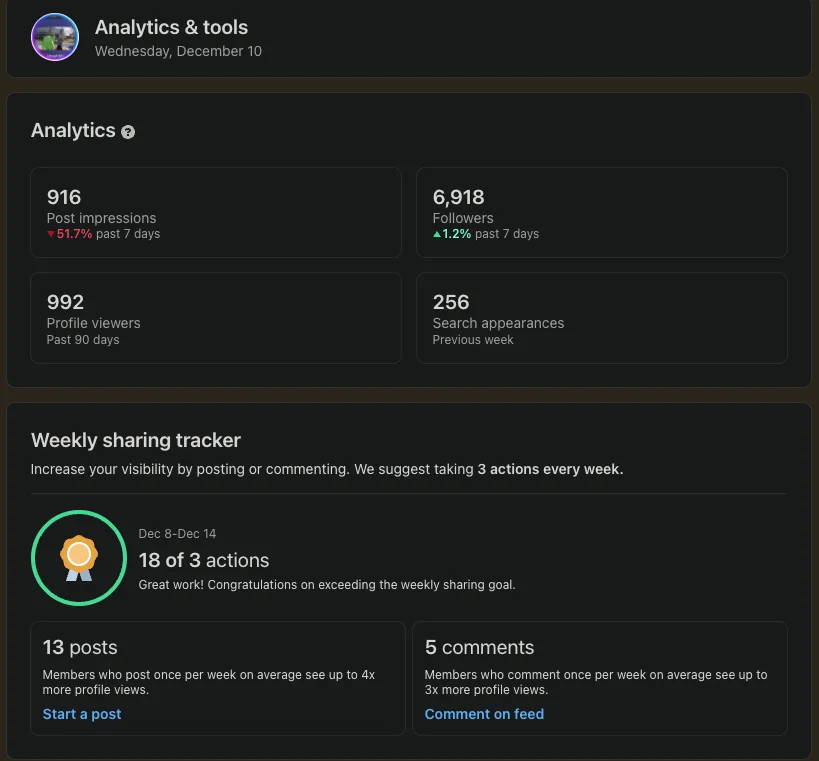
Here's a snapshot of my LinkedIn stats from 10 December 2025. I don't really give LinkedIn stats a lot of weight after being on the platform for 13 years now (since 2012), for some nearly 7000 followers/connections may seem a lot and it is for many, but I've seen some public speaker profiles with 200k+ and just on a personal or professional level, I haven't had much direct value come out of my LinkedIn connection count, maybe it's more motivational more than anything else, despite this I still like connecting with people both in-person and online. Getting key people who can be referrals helps as well.
3. Leverage Other Channels
This one is a HUGE one, relying solely on LinkedIn is a blackhole trap. Here are other free ways I got noticed:
- Company websites: Apply directly. Many companies prioritise direct applications over LinkedIn ones. Look for job hub websites such as https://iworkfornsw.gov.au to quickly source relevant jobs to apply for, you can take this further by searching "Information Technology 09 December" for example
- Professional communities & forums: For tech roles, places like GitHub, Stack Overflow and local Slack communities are gold mines.
- Meetups, Lumo and events: Networking in real life (or virtually) is can often be impactful.
By diversifying my approach, I increased my exposure and reduced reliance on LinkedIn algorithms.
It Finally Happened… I’m a Network Engineer!! (view original embed)
4. Tailor Every Application with your Cover Letter (and Resume but not as much)
Premium may give insights into who viewed your profile, but nothing replaces a personalised application. I made sure to:
- Align my resume with the job description: Highlighted skills and achievements that matched the role. Or better yet, make a few close variants of your resume and aggressively target roles within that field, e.g. "Cloud Engineer", "DevOps Engineer", and "Site Reliability Engineer" are all essentially the same role.
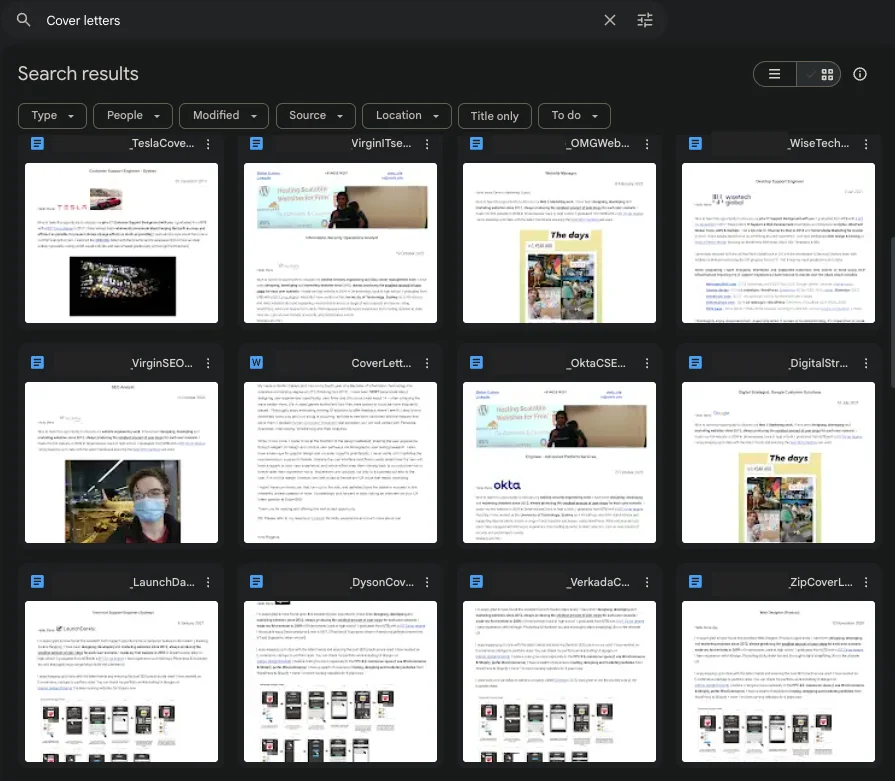
- Write customised cover letters: Even a few well-crafted sentences about why I wanted the role made a difference. Use tools like ChatGPT to help you 40x your application pipeline speed. Traditionally I found cover letters the most longest part to any job application but now they're a breeze with LLMs, always be sure to cross check them and add your flare to them though. Usually I chunk up paragraphs into certain parts of an existing cover letter and just manually merge it all together. ChatGPT free tier does a really good job these days so I don't have to check it much, just Ctrl/CMD-F em dashes, and "[", check cover letter title, signature roles, file titles and the date among anything in between.
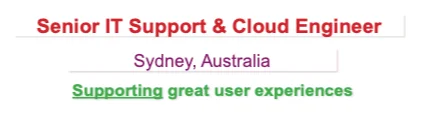
One example of a resume tagline I have in the header:
- Follow up politely: A brief follow-up email or LinkedIn message shows interest and keeps you on the recruiter’s radar.
Step 4.5. Leverage AI to Craft and Refine Application Materials
I used AI tools, mainly ChatGPT, but sometimes Gemini to help write tailored cover letters, re-write bios, and refine resumes for each role. This allowed me to quickly produce professional, customised cover letters and application question responses while still maintaining my personal voice. I treated AI output as a draft to review and adjust, ensuring each application truly reflected my skills and experience.
Just sample art of what my Cover Letters used to look like, due to file size and often 2 page limits on cover letters at Government jobs, I would limit to a header image depending on the company I was applying to. My file title would generally follow this:
FullName_Company/GovtDepartment_Role_Cover_Date
E.g.
JoeIcecream_ToysRUs_DevOpsEngineer_Cover_26Nov25
Recommended by LinkedIn
[
The 2026 Job Market Has Changed — Here’s How to Win in…
David Alto 5 months ago
](https://www.linkedin.com/pulse/2026-job-market-has-changed-heres-how-win-david-alto-0s2xc)
[
"How to Connect with Recruiters on Job Platforms in…
Muhammad Husnain 1 year ago
](https://www.linkedin.com/pulse/how-connect-recruiters-job-platforms-2025-muhammad-husnain-dfgfe)
[
Applying to More Tech Jobs Won’t Get You Hired…
Raphael Neves 1 year ago
](https://www.linkedin.com/pulse/applying-more-tech-jobs-wont-get-you-hired-what-raphael-neves-u1fdf)
Personalisation shows effort. Recruiters notice effort, not badges.
The AI Bubble is Worse Than You Think (view original embed)
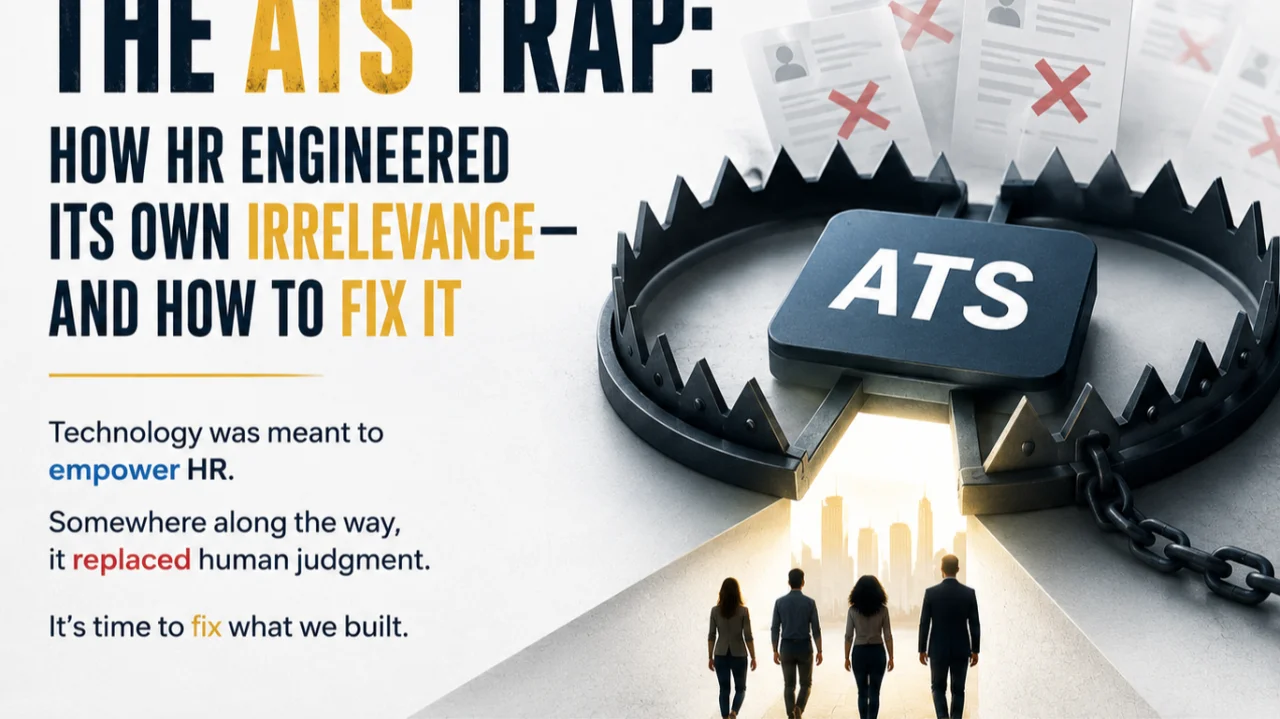
Step 5. Optimise Your Resume for ATS (Applicant Tracking Systems)
To increase the chances of your resume being seen by recruiters, I had about 3 different resumes depending on the role, more or less they looked very similar, just with different roles or headers included. I used clear headings, simple formatting, and standard fonts to ensure ATS software could easily parse my experience and skills. Where possible, I mirrored phrasing from the job posting to highlight alignment with the role while keeping the resume concise and easy to read for human reviewers.
6. Stay Consistent
Getting a job without Premium isn’t a magic trick, it’s about consistency. I spent 2-3 hours daily, sometimes more, sometimes less:
- Engaging on LinkedIn (whether it's news, attending events or connections)
- Applying to roles
- Networking
- Updating my profile
7. Strategically Apply to Multiple Roles Each Night
I set aside time in the evenings to apply to tens of roles, often choosing ones with upcoming deadlines to keep myself motivated. I prioritised positions that matched my skills and career goals, focusing on remote options where possible and weighing salary ranges to ensure each application was both strategic and purposeful. There are even times were I would apply outside the scope of my standard roles I would go for simply because they suited other criteria like transparent salary, local location/required PR/Citizenship and had a deadline to follow.
It paid off. After a few months, opportunities started coming in.
Why I’ve Walked Out of Every Job (view original embed)
8. Optional Step: Automate Applications with AI Tools
For those looking to save time and increase consistency, I explored AI-powered auto-application tools. These tools can help pre-fill applications, tailor cover letters to each role, and track submissions. While automation can accelerate the process, I made sure to review each application personally to maintain a high quality of standard and ensure alignment with each role as well as checking what each ATS required. Some tools exist like AIApply (mixed reviews) or auto-appliers on GitHub. Personally I didn't get one going and did value quality with the added speed of AI tools helping me for cover letters.
Again, not [yet] endorsing, but auto-appliers like these exist https://github.com/OscarC178/AI-Job-Application-CoPilot - You just need to be careful if they implement platform rate limiting so your LinkedIn or other job platform accounts don't get banned. Give Oscar R. Craven a follow.
What nobody is telling you about AI and jobs. (view original embed)
9. Open To Work and Leveraging Side Projects
After experimenting with this feature and asking other people for what they thought, I found it gave a better outward impression to keep it turned to Recruiters only. I also recommend having freelance or other contractual work you can list or talk about over having career breaks unless you have a valid reason. Personally I have never displayed a career break on my profile and having "freelance, CEO, Founder" aren't seen favourably by many Recruiters so tailoring your profile to have some kind of hybrid form of this seemed to be what I did. It wasn't too Founder-ish that I wouldn't look like I didn't have time for a new job and at the same time it wasn't too just "Individual contributor" - will work for any corporate job type profile either.
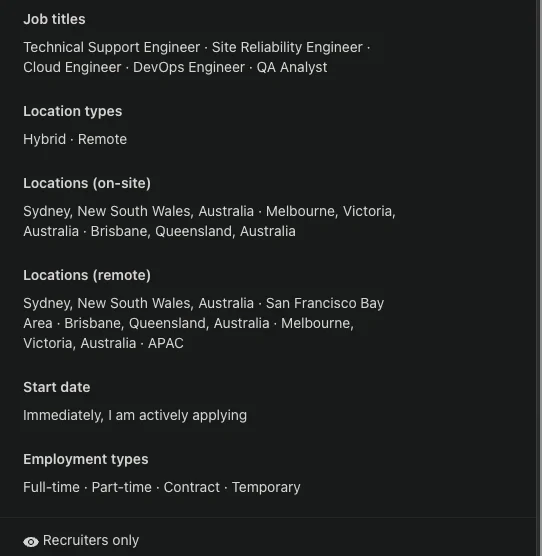
I also experimented with which "Job titles" I wanted Recruiters to search for when my profile was meant to supposedly pop up in their Sales Navigator or Recruiter dashboards. I don't think this feature works well, and often it ended in spammy recruiters reaching out for Right to Represent Authorisation emails which I haven't been fond of, or the dreaded "Can you convert your PDF resume to .docx, .doc" requests which is impossible coming from InDesign PDF exports unless you want a screenshot of the resume in a Word format which is unlikely and not efficient file size wise.
My Open to Work profile settings: (I never had other roles outside of Sydney, including remote, and had a few phone screens with Melbourne based roles), the biggest hurdle for securing a role outside of your native country will always be the work visa/securing sponsorship.
10. Have a Spreadsheet Index to Track and Motivate your Job Search and Applications
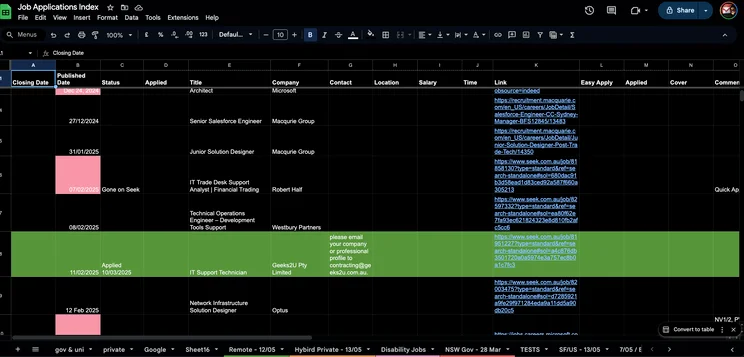
Keeping a simple spreadsheet to track your job applications can transform an overwhelming search into something structured and motivating. By logging roles, companies, application dates and current status, you turn invisible effort into visible progress and reduce the mental load of trying to remember everything. Each row becomes proof of action taken, even on days when rejections or silence make it feel like nothing is moving. Over time, this index helps you spot patterns, plan follow-ups, and approach your job search like a pipeline rather than a personal judgement, restoring a sense of control, momentum, and confidence. You can add multiple tabs for different categories of jobs e.g. Govt, Private sector, remote, hybrid and so on. I have some example here:
It doesn't have to be prefect, it just gets you started. That's al you need to keep going and keep track. Think of it like your steering wheel for your job search period. It didn't always need to update it, I would say I updated it more at the start of my job search journey and then progressively decreased my amount of time I updated it.
The Takeaway
LinkedIn Premium is nice, but it’s not essential. Optimise your profile, network genuinely, diversify your applications, and personalise every step. With persistence and strategy, you can land a job without ever clicking “Upgrade.”
The future will probably just be AI agents applying for us and AI HR agents reading them.
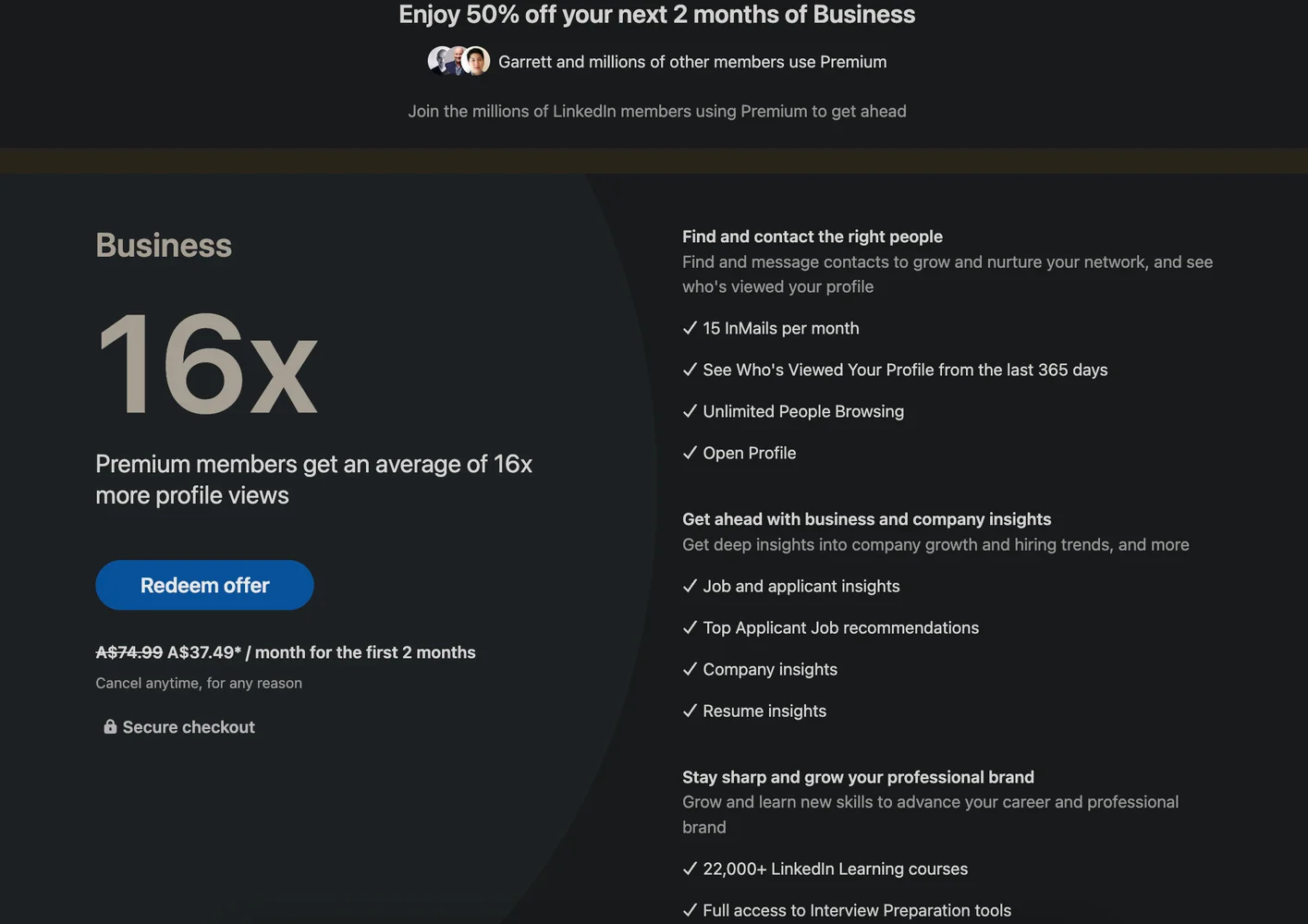
Partially throughout this process LinkedIn decided to start offering Business at 50% off for 2 months upon what seemed like every page, although tempting, since I already had my routine in place and was getting interviews elsewhere, I just tried to hold my ground in free tier land. I have tried LinkedIn Premium for free once many years ago and probably paid for 1 month, apart from other free promotions they used to dish out even on Sales Navigator. (It's not that much use as a Job Seeker though).
An infamous popup that would appear after each profile update.
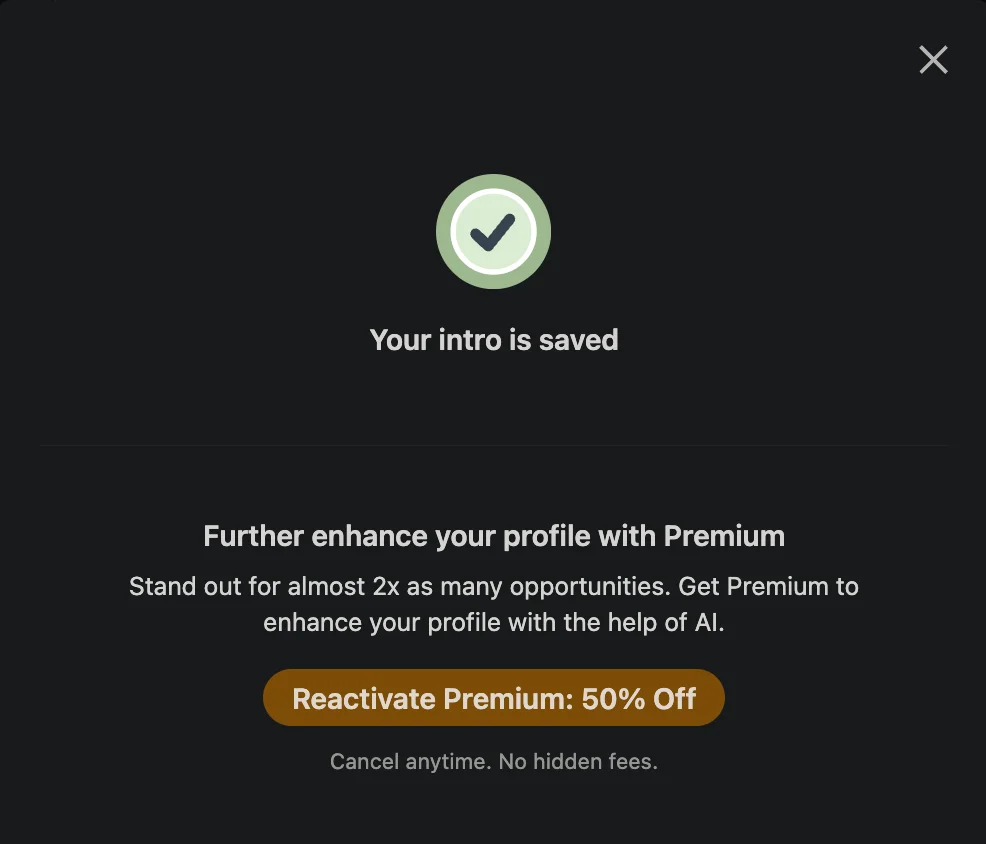
As a part-time web agency owner, it sure was tempted to get the Business plan to see service requests (haven't seen proof that this feature works) as well as who is actually viewing my profile beyond the 3 that LinkedIn shows for free, but I figured if someone really wanted to reach out they would and it seems in-person connections felt stronger but limited in reach or relevancy.
Not every application or interview is going to go your way, in fact after an estimated 1000 applications, I probably got about 30-40 interviews or phone calls and only 2 offers over 2 years. Hence why I said it definitely isn't 2021 times anymore where I got 4 offers in 1 year without needing to apply as much as I've had these previously few years. The tech job market seemingly has been on a decline since 2022, conversely when ChatGPT launched but inflation was already happening for years before that and it's when interest rates started rising as well from their all time lows in 2020 (around 2%).
PS 10 December 2025: This is version 0.8, I just had to "get it out there" just like how you should with job applications, the right time will never come, it's only the time you make which will be the right time to apply. Apply this to projects and startups as well.
My future aspirations include getting roles more aligned with my career growth at companies I actually envision being in, hopefully involving some travel already being in my 30s. US roles by fact tend to pay more and be better for career growth than roles I've seen in my local city (Sydney). It's just a known fact but my local city and country has its own lifestyle perks which would collectively be difficult to find elsewhere despite all of the cost of living pressures. Until another time.
Related articles:
2019: Why Your Sleep Is Worth More Than Your Awake Hours + Money Combined
Ex-Google Insider WARNS: "You Are Not Prepared For 2027" (view original embed)
Some additional videos:
5 Things You Must Do NOW to Survive the AI Job Takeover in 2026 (view original embed)
and just to balance things out here's a few about:
AI Was Supposed to Replace Developers... Until It Couldn't (view original embed)
And the AI Bubble stuff:
Four reasons OpenAI is doomed (view original embed)
Best,
Thanks for reading.
View the original discussion on LinkedIn ↗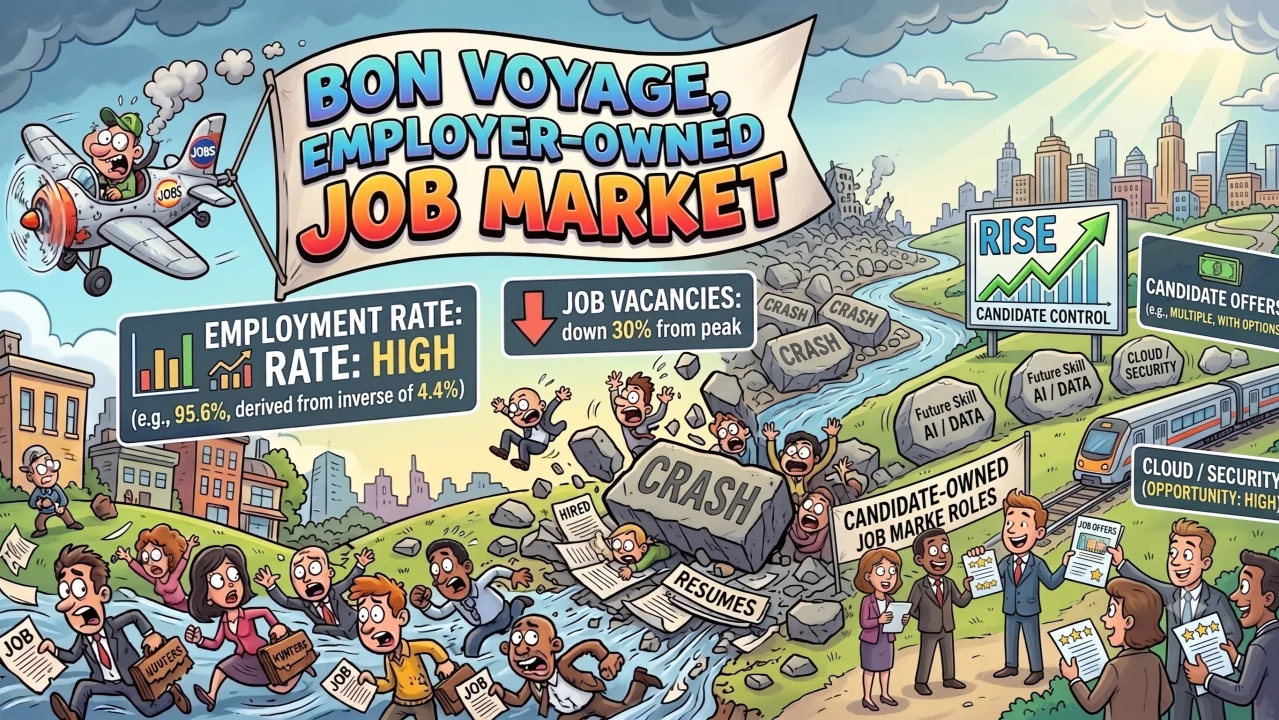
Join the conversation
Comments and reactions use GitHub. Sign in to join in, and keep the discussion thoughtful and respectful.
View discussions on GitHub ↗