When Will Be The End of Jobs: Living in an Agentic World by ChatGPT 5.3 in April 2026
Updated 7 June 2026 on LinkedIn
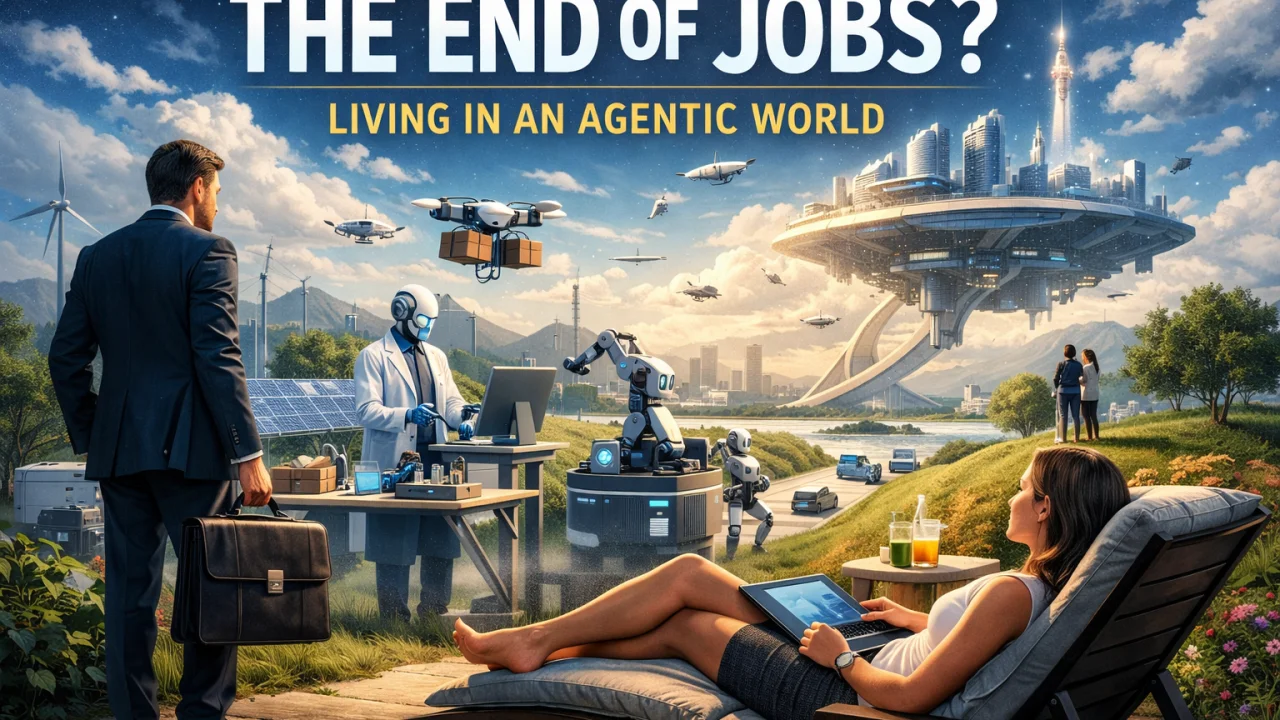
How will this AI renaissance play out? Fresh grads, mid tiers and even senior levels already feeling the heat as corporates layoff in the 100 000s since 2022.
Written by ChatGPT. (I know, how unironic, but lives up to the title). Also it was just before 5am AEST, GMT+10.
If you liked this, consider following Resuleet - planning on agentising your job search. We foresee a future of agent to agent communication for job hiring and more.
"AI Will Take Art, Then Jobs, Then Everything Else" - Tristan Harris (view original embed)
AI is eating the world as we know it. Entire white-collar and even blue/pink collar industries will be lost to AI at this rate. Worth a watch, even if it's only for a bit.
Part 1:
Prompts: Can you write an article about how we won't need jobs in the future due to an agentic world?
Can you add in a part about UBI?
The End of Jobs: Living in an Agentic World
For over a century, the idea of a “job” has been central to modern life. It structures our days, defines our identities, and underpins entire economic systems. But this concept may be far more temporary than we assume. As we move into an increasingly agentic world—one driven by autonomous AI agents capable of planning, executing, and learning independently—the necessity of traditional jobs begins to erode.
This is not just another wave of automation. It is a fundamental shift in how work itself is performed.
From Tools to Agents
Historically, technology has acted as a tool—something humans use to extend their capabilities. Even during the digital revolution, software required human direction at nearly every step. But agentic systems change this relationship. Instead of waiting for instructions, these systems can interpret goals, break them down into tasks, and execute them end-to-end.
An agent can already research a market, design a product, build a website, run marketing campaigns, and optimise outcomes—often with minimal human input. Multiply this across industries, and the implications become clear: entire roles, not just tasks, can be handled autonomously.
Eric Schmidt WARNS: "You Have No Idea What's Coming In 2027" (view original embed)
Ex-Google CEO shares his opinion and reality of AI advancement in 2026 and beyond.
The Collapse of Labour as a Constraint
The modern economy is built on scarcity—particularly the scarcity of skilled labour. Companies compete for talent because humans are the bottleneck in productivity. Agentic AI removes this bottleneck.
When intelligence and execution become abundant and near-instant, the marginal cost of producing goods and services drops dramatically. What once required teams of specialists can be achieved by a handful of agents operating in parallel. In such a world, hiring becomes optional rather than essential.
This leads to a profound question: if production no longer depends on human labour, what is the role of a job?
The Decoupling of Income and Work
One of the most disruptive consequences of an agentic world is the decoupling of income from employment. Today, people earn money by selling their time and skills. But if machines can perform most economically valuable tasks, this model breaks down.
We may see the rise of alternative systems:
- Ownership-based income (equity in platforms, agents, or digital assets)
- Community or cooperative models where value is shared rather than individually earned
In this context, “work” becomes less about survival and more about choice.
Universal Basic Income: A New Social Contract
As traditional employment becomes less reliable as a source of income, Universal Basic Income (UBI) is likely to move from fringe idea to mainstream policy discussion. At its core, UBI is a simple concept: every citizen receives a regular, unconditional payment sufficient to cover basic living costs, regardless of employment status.
In an agentic economy, UBI could serve several critical functions:
- Stability during transition: As jobs are displaced unevenly across sectors, UBI provides a financial safety net that reduces social shock and economic insecurity.
- Decoupling survival from labour: If machines generate the majority of economic value, it becomes increasingly rational to distribute a portion of that value directly to people.
- Enabling choice and creativity: With basic needs met, individuals are freer to pursue education, entrepreneurship, caregiving, or creative endeavours without the pressure of immediate income.
However, UBI also raises important questions:
- How is it funded—through taxation of AI-driven productivity, data, or capital?
- Does it risk inflation or dependency if not carefully designed?
- How does it interact with existing welfare systems and incentives to contribute?
Rather than a silver bullet, UBI is best understood as one possible pillar of a broader economic redesign. It represents a shift in thinking—from rewarding labour alone to distributing the benefits of automated productivity more widely across society.
What Happens When ONE Person Can Operate Like a Team? (view original embed)
Identity Beyond Occupation
For many, a job is more than income—it is identity, purpose, and social structure. The disappearance of jobs forces a cultural shift. People will need to redefine meaning outside of traditional employment.
This could lead to a renaissance of creativity, learning, and human connection. Freed from the constraints of mandatory work, individuals might pursue art, science, relationships, and exploration more deeply. At the same time, the transition may be psychologically challenging, particularly for those whose sense of self is closely tied to their profession.
The New Scarcity: Attention and Authenticity
While labour may become abundant, other forms of scarcity will emerge. Human attention, trust, and authenticity may become the most valuable resources.
In a world flooded with AI-generated content, genuinely human experiences and perspectives could carry a premium. Ironically, as machines take over functional tasks, the uniquely human qualities—emotion, intuition, presence—may become more important, not less.
Risks and Realities
The transition to an agentic world will not be smooth or evenly distributed. There are significant risks:
- Economic inequality if ownership of AI systems is concentrated
- Social disruption as industries and roles disappear faster than new systems emerge
- Governance challenges in regulating autonomous systems
It is also important to recognise that “the end of jobs” does not happen overnight. There will be a long period of overlap where humans and agents coexist, collaborate, and compete.
Recommended by LinkedIn
[
The New Rules of Tech Hiring in 2026
Iryna Haurylava 4 months ago
](https://www.linkedin.com/pulse/new-rules-tech-hiring-2026-iryna-haurylava-drpmc)
[
AI Won't Steal Your Job - But Someone Using AI Will!
Kamal Pabba 10 months ago
](https://www.linkedin.com/pulse/ai-wont-steal-your-job-someone-using-kamal-pabba-w23ec)
[
AI for Jobseekers: Part 3 - Building a self-populating…
Chris Gerben, PhD 7 months ago
A Post-Work Future
The idea that we “won’t need jobs” is not about eliminating human contribution—it is about redefining it. In an agentic world, contribution is no longer constrained by necessity. It becomes a matter of choice, creativity, and values.
We are moving from a world where humans work because they must, to one where they can choose what to do with their time. This is both liberating and destabilising.
The challenge ahead is not just technological—it is philosophical. We must decide what kind of society we want to build when work is no longer the organising principle of life.
The end of jobs, if it comes, will not be the end of purpose. But it will force us to find that purpose in entirely new ways.
Part 2:
I further prompted it:
When can we expect the end of mass jobs?
The honest answer: there probably won’t be a single “end” of mass jobs—but there will be a gradual tipping point where jobs stop being the default way society operates.
Here’s a grounded way to think about the timeline.
🟡 2025–2030: Augmentation → Early Displacement
We’re already here.
Agentic AI systems are starting to:
- Automate multi-step knowledge work (coding, support, analysis)
- Replace tasks, not whole roles (yet)
- Let 1 person do the work of 3–10
What happens:
- Hiring slows in many white-collar fields
- Companies quietly don’t backfill roles
- Freelancers and contractors feel it first
👉 Jobs still exist—but fewer people are needed per company.
🟠 2030–2040: Role Collapse
This is where things get real.
Agentic systems will likely:
- Run entire workflows end-to-end (e.g. marketing, IT ops, finance ops)
- Coordinate with other agents autonomously
- Improve themselves over time
What happens:
- Entire job categories shrink or disappear
- “Teams” become 1–2 humans + many agents
- Entry-level roles get hit hardest (big deal long-term)
👉 This is the first phase where mass jobs start to feel unnecessary.
🔴 2040–2055: Economic Decoupling
This is the tipping point era.
If AI keeps progressing:
- Labour is no longer the bottleneck
- Productivity becomes near-abundant
- Cost of many services approaches zero
What happens:
- Governments are forced to rethink income systems
- Work becomes optional for a growing % of people
- Traditional employment stops being the main income source
👉 This is when “mass jobs” stop being structurally required.
🟢 2055+: Post-Work (But Not Post-Activity)
Jobs don’t disappear completely—but they become:
- Voluntary
- Passion-driven
- Status-based rather than survival-based
Think:
- Creators, builders, explorers
- People running things because they want to, not because they need to
⚠️ The Real Constraint Isn’t Tech — It’s Society
Technically, we could reach heavy job displacement faster than expected (even within 10–15 years).
But what slows things down:
- Politics and regulation
- Cultural attachment to work
- Economic systems built around wages
- Resistance from institutions
👉 So the timeline is less about can we? and more about will we allow it?
🧠 The Bottom Line
- You’ll likely see serious job erosion within your lifetime (next 10–20 years)
- But a full “no jobs needed” world is more like a 20–40 year transition
- The shift will feel uneven, messy, and psychologically strange—not clean or obvious
You're an avid reader! If you liked this, consider following Resuleet - planning on agentising your job search. We foresee a future of agent to agent communication for job hiring and more.
Thanks for reading.
View the original discussion on LinkedIn ↗
Join the conversation
Comments and reactions use GitHub. Sign in to join in, and keep the discussion thoughtful and respectful.
View discussions on GitHub ↗